
Coffee Table Malaysia: Size, Height & Buying Guide
How to choose a coffee table in Malaysia — the size, height and shape rules that actually matter, plus tops and finishes that survive our humidity.
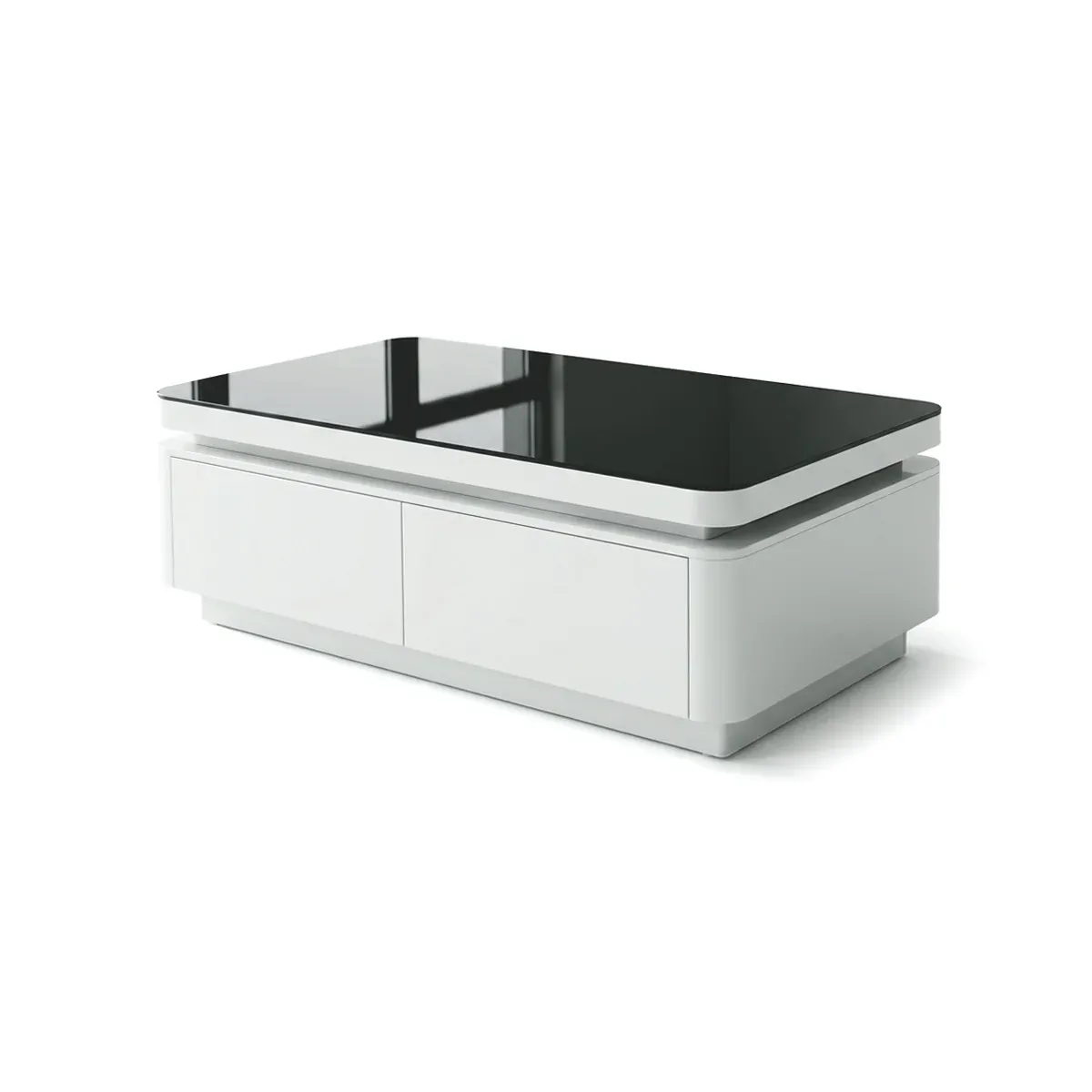
A coffee table is the one piece of living-room furniture everybody touches and almost nobody measures. It carries the drinks, the remotes, the laptop and the takeaway; it holds the seating group together visually; and if it is 8 cm too tall or 40 cm too long, you feel it every single evening. Choosing a coffee table in Malaysia — the meja kopi, as most of us call it — adds two local constraints: condo and terrace living rooms that must fit a sofa, a TV wall and a walkway into one narrow space, and a climate that is unkind to unsealed stone and poorly edged board. TD Furniture has built furniture in Perak since 2002, so here is how we would work through the decision — the numbers first, then shape, materials and the day-to-day reality of living with it.
What a coffee table actually has to do
Before the finish and the styling, be honest about the job. A coffee table does three things at once, and most buying mistakes come from optimising one and forgetting the other two.
- Surface. Somewhere to put a cup down without leaning out of your seat. The practical test is simple: every regularly used seat should be able to reach the table without standing up.
- Storage. Remotes, chargers, coasters, magazines, the children's colouring things. Open shelves, drawers or a lift-top decide whether the surface stays clear or slowly disappears.
- Circulation and proportion. It anchors the seating group and fills the gap between the sofa and the TV cabinet, but it also has to leave people a way to walk through the room. This is the job that gets sacrificed when someone buys a table they fell in love with online.
Sometimes the honest answer is that you do not need one. If your sofa faces a walkway, if the room is under about 3 m wide, or if you have a crawling toddler, a pair of side tables or a nest of two will serve you better: they give you a surface next to each seat, they can be pulled apart when guests arrive, and they push back against the wall when the floor is needed. A small coffee table that leaves the room usable beats a generous one you keep sidestepping.
Coffee table size: the dimensions that matter
Start from the sofa, not from the room. Nearly every proportion rule for coffee table size is expressed relative to the seating in front of it, because that is the relationship your eye actually reads. Measure the sofa first, then the walkways, and only then go shopping.
- Length: about half to two-thirds of the sofa. Measure the seating area from the inside of one armrest to the inside of the other and take roughly two-thirds of it — that is the length designers reach for most often. So a 2.1 m three-seater usually pairs with a table somewhere around 100–130 cm long.
- Gap to the sofa: 30–45 cm. This is the reach zone. Closer than about 30 cm and your knees hit it when you stand; further than 45 cm and you have to lean forward off the cushion to reach your drink. Around 40 cm suits most people.
- Walkways: 60–90 cm. Leave at least 60 cm anywhere someone has to squeeze past, and closer to 90 cm on the main route through the room — the path from the door to the sofa, or the route to the balcony or dining area.
- Depth: 45–60 cm. Below about 45 cm a rectangular table starts to feel like a bench and cannot hold a tray; beyond 60 cm you are reaching across it, and the far half becomes storage for things nobody moves.
- Round tables: 80–100 cm diameter is the usual sweet spot in front of a three-seater. Under 70 cm it reads as an oversized side table; over 110 cm it starts to swallow the walkway on all four sides at once.
- Leave breathing room at the ends. The table should not run the full width of the sofa — a visible gap of roughly 15–30 cm at each end is what makes the pairing look deliberate rather than wedged in.
One trick worth ten product photos: mark the footprint on your floor with masking tape, or cut a cardboard rectangle to size, and live with it for a couple of days. Walk to the balcony, carry a laundry basket past it, let the children run through. If you keep stepping around it, size down before you buy — not after delivery.
Coffee table height: match it to the sofa seat
The rule for coffee table height is refreshingly simple: the top should sit level with the sofa seat, or up to about 5 cm below it. Level feels natural for putting things down; slightly lower looks lighter and keeps the sightline across the room open. Higher than the seat almost always looks wrong and makes the room feel cramped.
Most sofa seats sold in Malaysia sit somewhere around 40–45 cm from the floor to the top of the compressed cushion, which is precisely why the majority of coffee tables land in the same 40–45 cm range. Measure your own sofa with someone sitting on it, or press the cushion down with your hand — a soft feather-filled seat can lose 4–5 cm under load, and measuring it uncompressed is the most common way people end up with a table that is visibly too tall. If you have not bought the sofa yet, settle that first; our comparison of L-shape sofas versus a 1+2+3 set works through that decision.
The taller "café height" exception
If your living room is where you actually eat dinner, work on a laptop or help with homework, the standard height will have you hunched over. A taller table at roughly 50–60 cm — sometimes sold as café or cocktail height — brings the surface close to elbow level so you can eat and type without folding forward. The trade-off is visual weight: a tall top blocks more of the room and can look bulky in a small condo. A lift-top table is the middle path, sitting at normal height and rising to about working height when you need it.
Shape: rectangular, round, square or a nest
Shape is not a style decision so much as an answer to your sofa layout and your traffic flow. Match the table to how the seating is arranged and the room organises itself.
- Rectangular — the default for a straight three-seater and the most efficient shape in a long, narrow living room. It gives the most usable surface per square metre of floor and lines up neatly with the sofa and the TV wall.
- Round — the best answer for tight condo living rooms, awkward corners and homes with young children, because there are no corners to walk into or fall against. A round coffee table also softens a room full of straight lines and lets people cut past it diagonally, which effectively widens a narrow walkway.
- Square — suits a squarish room and a sofa arrangement that wraps around it, such as a three-seater with two armchairs facing in. Reach is even from every side, but a square table eats more floor than a rectangle of the same usable top.
- Nest or pair — two tables that tuck together and separate when needed. The most flexible option in a small space and the easiest to live with in a rental, since they adapt to whatever room they land in next.
With an L-shape sofa, the geometry changes. The table should sit within the L rather than in front of one arm of it, keeping 30–45 cm clear from both runs of seating. A square or round table usually reads better there than a long rectangle, which tends to leave a dead triangle at the corner and blocks the chaise. If your sofa has a chaise or an ottoman, measure to the chaise as well — that is where the clearance is usually lost.
Coffee table materials for Malaysia's climate
Every top material trades something away. In our climate — humidity that can swing from above 80% after an afternoon downpour to something much drier inside an air-conditioned room within the hour — the honest comparison matters more than the showroom photo.
Sintered stone and ceramic
Sintered stone is a mineral surface compacted under very high heat and pressure. It is non-porous, so coffee, curry oil and red wine sit on top instead of soaking in, it needs no sealing, and it handles heat far better than most surfaces. For a table that gets hot drinks, hotpot dinners and children daily, it is the most forgiving stone-look top on the market. The trade-offs are honest ones: the pattern is printed and repeats across slabs rather than being unique, a heavy impact on an edge or corner can chip it, and it is still a rigid slab that needs a properly engineered frame under it.
Natural marble
Nothing else looks like real marble, because every slab is genuinely one of a kind. But a marble coffee table is a material with opinions. Marble is porous and reacts to acid, so coffee, lime juice, wine and some household cleaners can leave a dull etched mark even when the surface is not stained. It needs re-sealing periodically — a typical recommendation is every few years, sooner on a heavily used top — and it is heavy, which matters on an upper floor, in a lift and when two people have to lift it into place. Buy marble if you accept a surface that ages and gains character; choose sintered stone if you want it to look the same in five years. We cover the same comparison for dining surfaces in our dining table buying guide, and the logic carries straight over to a coffee table.
Tempered glass
Glass is the small-room specialist. Because you see the floor through it, a glass top takes up almost no visual space, which is exactly what a compact condo living room needs. Insist on tempered glass — it is several times stronger than ordinary glass and, if it does fail, breaks into blunt granules rather than shards — and look for a top around 10 mm or thicker with polished or bevelled edges. The daily reality: fingerprints, dust and water marks show on glass more than on any other material, and while the face of a tempered panel is tough, a sharp knock on an exposed corner is its weak point. Households with toddlers should think twice, or choose a rounded shape.
Solid wood, veneer and engineered board
A wooden coffee table is the warmest option and the easiest to match with the rest of a room. Solid timber moves with the seasons even here — it takes on moisture from humid air and gives it back in air-conditioning — so the things that matter are that the timber was properly kiln-dried and that the construction allows for that movement. Veneer over engineered board is more dimensionally stable than a wide solid panel and gives you a consistent grain, but the finish and the edge banding do all the protective work: moisture finds any raw or badly bonded edge first. On any wood top, standing condensation is the real enemy — a cold glass left overnight is what leaves a white water ring.
Metal frames and legs
Most modern tables carry the top on a steel frame, and in a humid coastal climate the coating is what determines its life. A properly prepared, oven-cured powder coat is far more durable than a thin decorative plating, which can pit and lift over time, particularly in Penang and other seaside homes. Check the welds where the legs meet the frame, check that the table does not rock on a level floor, and add felt pads under the feet — they protect tiles and let you slide the table instead of dragging it.
Storage: drawers, shelves, lift-tops and nesting sets
A coffee table with storage earns its place in a home without much other living-room cabinetry, and gets in the way in a home that already has plenty. Decide what actually needs to live in the middle of the room before you pay for the volume.
- Drawers hide clutter completely, which is why they suit an open-plan condo where the living room is visible from the door. Check that the drawer can be opened from the seated position — a drawer that opens towards the sofa with only 30 cm of clearance is a design that looks better than it works.
- Open lower shelves are cheaper, lighter and keep books and remotes visible. The catch is that they are visible: a shelf shows every bit of mess, so they suit tidy households and look best with a couple of baskets on them.
- Lift-tops raise the surface to working height and usually hide storage underneath. Genuinely useful if you work or eat there, but the mechanism adds cost, weight and one more thing that can wear out — test the action in the showroom.
- Nesting sets store nothing but flex enormously: one table most days, two when guests arrive, and both pushed aside when the floor is needed. Often the smartest choice for a condo living room.
- No storage at all is a legitimate answer. If you already have a TV cabinet or a sideboard doing the storage work, an open-frame table keeps the floor visible and the room feeling larger.
If the size or finish you need does not exist off the shelf — a narrower top for a tight walkway, a height that matches an unusually low sofa, a finish that has to sit with existing cabinetry — that is exactly what customisation is for. Building to the room is usually cheaper than rearranging the room around a standard piece.
Living with it: care by material, and what to check before you buy
Two habits protect any coffee table better than any product you can buy: use coasters, and never treat the top as a trivet. Heat is a risk on marble, on wood and on any glued veneer, and condensation is a risk on everything except stone and glass. Wipe spills as they happen rather than at the end of the evening — on a porous surface the first few minutes are what decide whether a mark stays.
- Sintered stone and ceramic — warm water and mild detergent, dried off afterwards. Avoid dragging anything gritty across it, and never chop directly on the surface.
- Marble — blot rather than wipe, use a pH-neutral cleaner made for stone, and keep vinegar, lemon, bleach and general-purpose bathroom sprays away from it. Re-seal on the schedule your supplier recommends.
- Tempered glass — a microfibre cloth with a little glass cleaner or diluted vinegar, buffed dry so it does not streak. Lift objects rather than sliding them; grit under a ceramic base is what scratches glass.
- Wood and veneer — a barely damp cloth followed by a dry one, always along the grain. Keep it out of direct afternoon sun through a window, which fades and dries the finish faster than daily use ever will.
- Metal frames — wipe with a damp cloth and dry immediately, especially near a coastal window or an open balcony where salt air is in play.
Before you pay, run through this quick checklist:
- Measure your sofa seat height with the cushion compressed, and the inside width between the arms.
- Chalk or tape the table footprint on the floor and walk around it for two days.
- Check every walkway still gives you 60 cm minimum, 90 cm on the main route.
- Push down hard on one corner in the showroom — a good table does not flex, rock or creak.
- Ask what the top actually is: sintered stone, ceramic, natural marble, tempered glass, solid timber or veneer on board. The words are often used loosely online.
- Confirm the delivery route: lift dimensions, staircase turns and doorway width, because a stone top is heavy and cannot be tilted freely.
- Check care instructions and warranty before you pay, not after the first spill.
Frequently asked questions
What size coffee table suits a three-seater sofa?
Take the length between the inside faces of the two armrests and aim for about two-thirds of it. On a typical 2.1 m three-seater that puts you around 100–130 cm long and 50–60 cm deep, with the table centred on the sofa and about 40 cm of clearance in front. If the room is tight, go shorter rather than narrower — a table that is too shallow stops being useful, while a slightly short one still looks fine.
Is a round coffee table better for a small living room?
Often, yes. A round table has no corners to catch a shin or a toddler's forehead, and because people can cut past it on the diagonal, it makes a narrow walkway feel wider than a rectangle of the same footprint. It also pairs well with an L-shape sofa, sitting comfortably inside the corner. The trade-off is usable surface: a circle gives you less flat area than a rectangle of the same overall size, so if the table has to hold dinner for four, a rectangle or a nesting pair may serve you better.
Should the coffee table match the TV cabinet and side tables?
Matching everything exactly can look like a showroom display. The easier route is to repeat two of three elements — the wood tone, the metal finish or the top material — across the coffee table, the side tables and the TV console, and let the shapes differ. A common and reliable combination is a stone or glass top on the coffee table echoing the stone in the TV feature wall, with legs in the same finish as the console. Our TV cabinet design guide has more on tying the living-room pieces together.
TD Furniture has manufactured furniture in Malaysia since 2002 and sells factory-direct, so you can compare tops and frames side by side across the whole living-room range and have a piece sized to your room. Bring your sofa measurements to a showroom in Perak or Penang, or send them to us on WhatsApp and we will tell you which sizes fit before you make the trip.
