
Display Cabinet Malaysia: A Practical Buying Guide
Buying a display cabinet in Malaysia? Glass vs open shelves, 1 vs 2 vs 3 doors, sizing, humidity-proof materials, LED lighting and dust control.
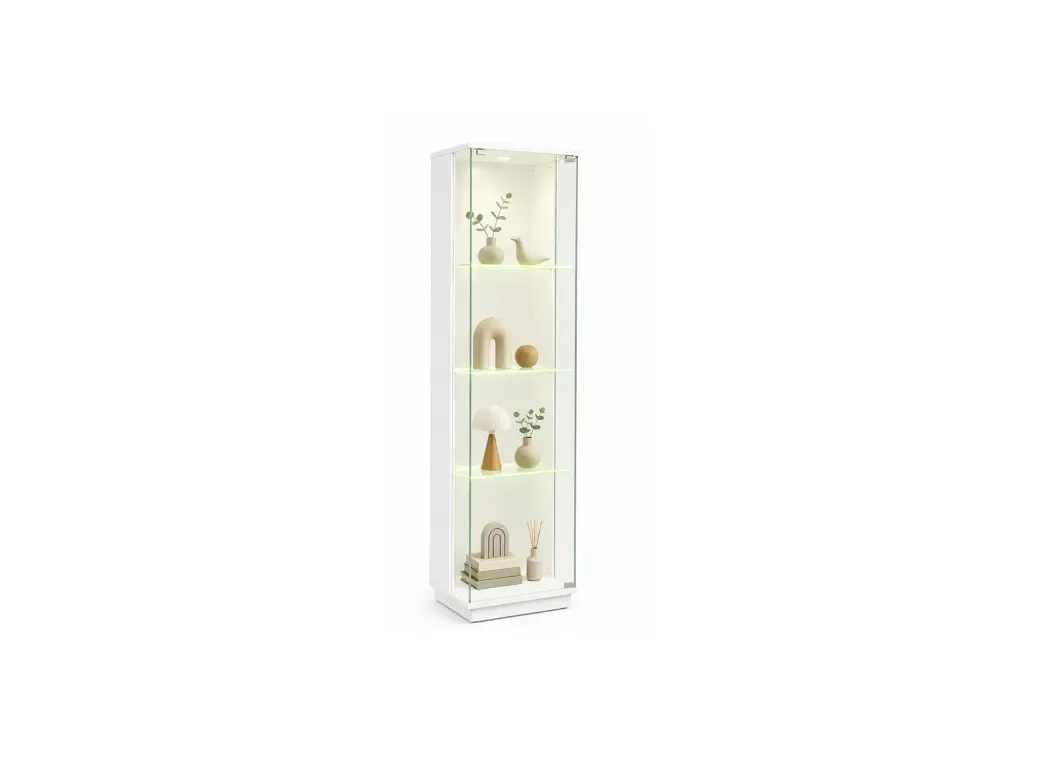
A display cabinet is one of the few pieces of furniture asked to do two jobs at once: store things, and show them off. Buying a display cabinet in Malaysia adds a third: surviving a climate that sits near 80% relative humidity for most of the year, in a living room where the ceiling fan runs all day and dust settles fast. This guide is for someone standing in front of a wall with a tape measure, deciding what to actually buy: glass doors or open shelves, how many doors your wall can take, what depth works, which materials last here, and whether the LED lighting is worth paying for. Everything below applies whether you are browsing our display cabinet range or measuring for a custom build.
First decide what the cabinet is really for
"Display cabinet" covers a surprisingly wide range of furniture, and the right choice depends entirely on what goes inside. Before looking at a single photo, take an honest inventory of the shelf, because collectibles, crockery and paperwork all want different things.
- Things you want seen: figurines, model cars, trophies, souvenirs from trips, a tea set, whisky bottles. These need glass, light and shallow shelves so nothing hides at the back.
- Things you want stored but reachable: dinnerware, glassware, board games, table linen. These want a closed base and a solid shelf that carries weight.
- Things you want hidden: documents, chargers, medicine, the router. Every display cabinet should have at least one opaque compartment, or the clutter ends up on top of it.
- Things that must not fade: photos, books, paper collectibles, anime figures with printed decals. These want a spot away from direct sun and a low-heat, low-UV light source.
That inventory also tells you whether you actually need a display cabinet at all. If the goal is mostly closed storage along a wall, a sideboard from our console tables and sideboards range does the job with less dusting. If the wall is really about the television, a TV cabinet with a tall display column beside it is usually the better answer. We cover that layout in the TV cabinet design guide.
Glass doors, open shelves or a closed base?
This is the decision that shapes everything else. A glass display cabinet keeps dust off and makes a collection look deliberate; open shelves are cheaper, airier and far easier to rearrange, but in Malaysian homes they need wiping every week. Most good living room cabinets are a hybrid: glass above, solid doors below.
| Type | Best for | Trade-off |
|---|---|---|
| Full glass-door cabinet | Collections you look at often: figurines, crystal, curios. Glass on the front and sides lets light through from both angles. | Fingerprints on the glass, and everything inside is on permanent show, so it has to stay tidy. |
| Glass top, closed base | The all-rounder for a family living room: display where it counts, hidden storage for the rest. | Less display volume than a full glass unit; the base can become a dumping ground. |
| Open-shelf column | Books, plants, larger decor pieces and rooms that feel cramped: no doors means no visual weight. | Dust lands on every surface. Not for delicate or small collectibles. |
| Tall narrow LED tower | Small living rooms and awkward gaps. Draws the eye upward and takes very little floor. | Must be anchored to the wall; limited storage volume overall. |
| Built-in display wall | Long walls, alcoves and awkward corners. Floor-to-ceiling use of the space with no dust ledge on top. | Fixed in place, longer lead time, needs measuring on site. |
One detail worth checking on any glass unit: whether the glass is tempered. Tempered glass is heat-treated to be considerably stronger than ordinary annealed glass, and if it does break it crumbles into blunt granules instead of long shards, which matters in a house with children or pets.
How many doors? Matching the cabinet to your wall
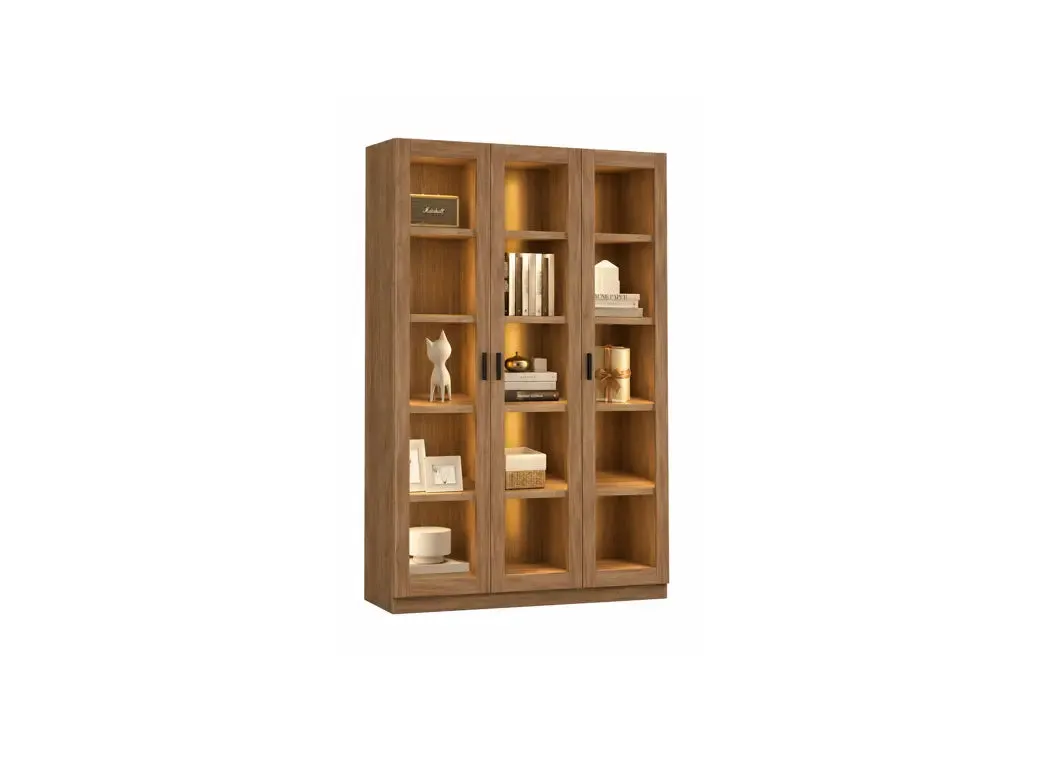
Most shoppers pick a cabinet they like and then hope it fits. Do it the other way round. Measure the clear wall (skirting to skirting, minus any door swing, switch plate or air-cond drop), then choose the door count that fills it comfortably. Several of our designs come in more than one width of the same cabinet (the Oslin and Isla series in 1-door, 2-door and 3-door versions, and the Ludo in 2-door and 3-door), which is exactly how you should be thinking: same look, pick the width your wall can take.
| Configuration | Typical width | Works best when |
|---|---|---|
| 1 door (single column) | About 40–60 cm | You have a gap beside a doorway, a corner, or want a pair flanking a TV feature wall. |
| 2 door | About 80–100 cm | The default for a standard living room or dining wall: enough presence without dominating. |
| 3 door | About 110–140 cm | A long unbroken wall, or a dining area where the cabinet is meant to be the focal point. |
| Two columns, split | Varies | You want symmetry around a TV, a window or an archway rather than one long run. |
Two rules stop most fitting disasters. Leave 5–10 cm of breathing space on each side rather than filling the wall to the millimetre: furniture that touches both walls looks wedged in, and you will want to reach behind it eventually. And check the delivery route before the wall: staircase turns, lift dimensions and corridor width defeat more tall cabinets than living rooms do.
Depth, shelf height and placement
Depth is where display cabinets differ most from other storage. A wardrobe needs 60 cm; a display cabinet usually works best at 30–40 cm. Anything deeper and the back row disappears into shadow, you stop being able to reach it, and the cabinet starts eating into the walkway. Shallow is a feature, not a compromise.
- Shelf clearance. Work from your tallest item, then add about 5 cm of headroom so pieces can be lifted out rather than dragged. Adjustable shelf pins are worth insisting on: a collection changes, a fixed shelf does not.
- Eye level is the prime slot. Roughly 140–160 cm off the floor is where a standing adult looks first. Put the best pieces there and the everyday clutter below.
- Heavy things low. Crockery, glassware and anything with weight belongs on the bottom shelves: better for stability, and easier on the glass.
- Leave a walkway. Keep at least 75–90 cm of clear floor in front so doors open fully and people can pass without turning sideways.
- Anchor tall units to the wall. Any narrow tower over about 1.5 m should be strapped or bracketed: a loaded top shelf raises the centre of gravity, and children climb.
- Watch the sun. A west-facing window in Malaysia will bleach printed boxes, book spines and fabric within a year or two. Set the cabinet on a side wall instead of directly opposite the glass.
Display cabinet materials for Malaysian humidity
A display cabinet lives indoors, so it has an easier time than an entryway shoe cabinet, but our climate still punishes weak materials, especially in ground-floor living rooms and homes near the coast. The same logic we set out in the shoe cabinet guide applies here, just less severely.
- Engineered board with sealed edges. Perfectly fine indoors: the point is the edge banding. An unsealed or peeling edge is where humidity gets into the core, and once a board swells it never comes back.
- Moisture-resistant plywood. Cross-laminated layers hold their shape better than plain particleboard, which is worth paying for if the cabinet sits against an external wall that sweats.
- Solid wood. The best-looking option and the most sensitive: it expands and contracts with the air, so keep it out of direct sun and away from a leaking air-cond unit.
- Metal or aluminium frames. Do not absorb water, will not warp, and give a slim profile that suits a glass cabinet visually.
- Back panel. A mirrored back doubles the apparent depth and bounces light around; a solid painted back is calmer and hides the wall behind. A thin open back collects dust and looks cheap up close.
- Hinges and runners. Metal soft-close hinges on a glass door are the difference between a cabinet that still shuts flush in year five and one that rattles. Cheap plastic fittings are where a low quote usually hides.
Getting the glass shelves right
Glass shelves keep a cabinet looking light and let LED light pass through to the shelf below, but they need to be specified properly. A common trade rule of thumb allows roughly 1 mm of glass thickness for every 10 cm of unsupported span, so a 60 cm shelf wants about 6 mm and a 90 cm shelf closer to 8–10 mm. For a home glass cabinet, 6 mm is fine for a short span with light items, 8 mm tempered is the safe default for anything wider or heavier. Ask for tempered glass and polished edges, and if you plan to load a shelf with dinner plates, put those on a timber shelf instead.
Is a display cabinet with LED light worth it?
Yes, it is the single upgrade that changes a storage cupboard into a display. Ceiling downlights hit the top of a cabinet and leave every shelf below in shadow; a strip inside the cabinet lights the objects themselves. A display cabinet with LED light built in, like our Munich and Linea cabinets, has the wiring and channels already integrated, which is far tidier than sticking a strip on afterwards.
- Colour temperature. Warm white (about 2700–3000K) flatters wood, glassware and a tea set and matches most Malaysian living room lighting. Neutral white (around 4000K) keeps colours true, which suits figurines, models and anything with printed detail.
- Where the light sits. A strip hidden behind the front rail of each shelf lights the objects; an edge-lit glass shelf glows along its own edge and spills light downward. Both beat a single lamp at the top.
- Low heat, low UV. Good LED strips run cool and emit little ultraviolet, which is what fades paint and paper over time. Keep the strip out of contact with the items themselves.
- Dimmable, on its own switch. Full brightness for guests, low glow at night. Being able to leave it off is as useful as being able to turn it on.
- Plan the plug point. Decide early which side the cable exits and whether there is a socket there. Retrofitting a power point behind a finished cabinet is nobody's favourite job.
Dust, cleaning and styling
Every complaint about a display cabinet after the first year is about dust. Glass doors solve most of it, but only if they close properly: a warped door or a missing catch lets a fine layer settle inside anyway. Wipe the glass with a microfibre cloth and a little diluted glass cleaner sprayed onto the cloth, never onto the cabinet, so nothing runs into the joints or the edge banding. Once every few months, take everything out, wipe the shelves dry and check the corners for grey mould speckles, which is our climate's early warning sign.
Styling follows one principle: a display cabinet is not a warehouse. Leave roughly a third of each shelf empty: negative space is what makes the remaining pieces read as a collection rather than a pile. Group items in odd numbers, vary the heights within each group, and let one shelf hold a single large object as a breather. Keep colours to a family of two or three, put the tallest items at the back edge, and turn labels and packaging boxes so the printed face is consistent. If the cabinet sits beside an entryway, the same restraint applies to what accumulates on top of it. That is what a hall cabinet or shoe cabinet is for.
Display cabinet questions, answered
What is the standard depth of a display cabinet?
Most display cabinets sit between 30 and 40 cm deep. That is enough for one or two rows of objects while keeping everything visible and within reach. Deeper than about 45 cm and the back row falls into shadow, and the cabinet starts to intrude on the walkway in a typical Malaysian living room.
Should I choose a 1, 2 or 3 door display cabinet?
Measure the clear wall first, then subtract 5 to 10 cm of breathing space on each side. As a rough guide a single-door column suits gaps of about 40 to 60 cm, a two-door cabinet suits a standard living room wall at roughly 80 to 100 cm, and a three-door version needs a long unbroken run of about 110 to 140 cm. Ranges like Oslin and Isla offer the same design in all three widths, and the Ludo comes in two and three doors, so you can scale to the space instead of compromising on the look.
Is a glass display cabinet safe with children in the house?
It can be, with three precautions. Insist on tempered glass, which is much stronger than ordinary glass and crumbles into blunt granules rather than sharp shards if it fails. Anchor any tall or narrow cabinet to the wall with a strap or bracket. And load the heaviest items on the lowest shelves so the centre of gravity stays low.
How do I stop dust building up inside the cabinet?
Closed glass doors that shut flush are the main defence, so check the hinges annually and adjust them if a door stops sitting square. Avoid open-back designs in a fan-driven room, wipe the exterior weekly with a microfibre cloth, and do a full empty-and-wipe every few months. Spray cleaner onto the cloth rather than the cabinet so liquid never runs into the joints.
Warm white or neutral white LED for a display cabinet?
Warm white at around 2700 to 3000K suits wood finishes, glassware, crystal and dinner sets, and blends with the warm lighting most Malaysian living rooms already use. Neutral white at around 4000K renders colour more accurately, so it is the better pick for figurines, model kits and anything with printed detail you want to see truthfully.
Can a display cabinet double as a TV cabinet?
A low display unit can sit under a television, but the two have different requirements: a TV cabinet needs cable management, ventilation for a set-top box or console, and a top surface at seated eye level. The tidier arrangement is a low TV cabinet with a tall display column beside it, which also gives the wall a bit of height variation.
