
Shoe Cabinet Malaysia: The Complete Design & Sizing Guide
Planning a shoe cabinet in Malaysia? Practical sizes, materials for our humidity, ventilation that stops odour and mould, plus entryway design ideas.
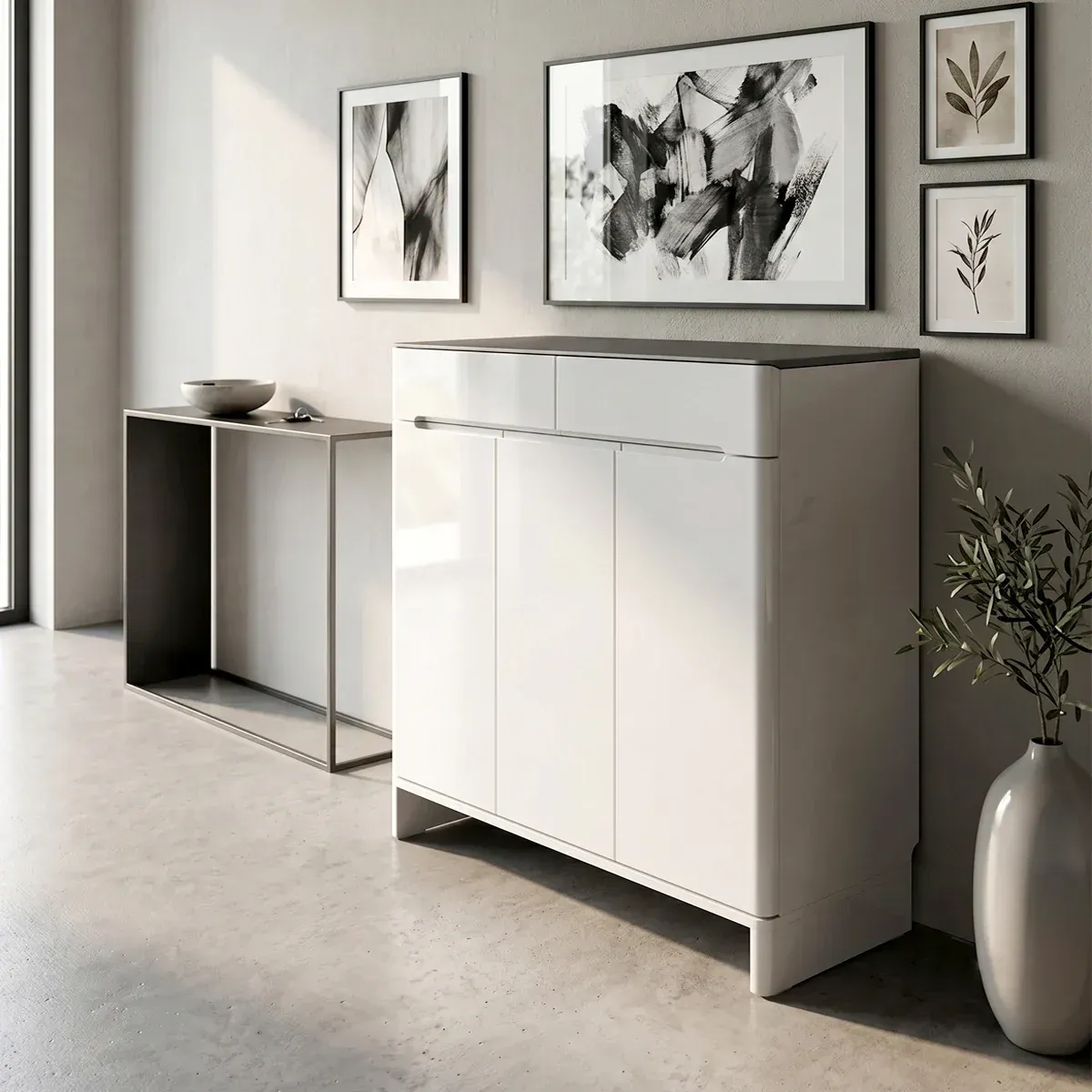
A shoe cabinet in Malaysia has a harder job than the same piece of furniture almost anywhere else. We take our shoes off at the door, so every pair in the house lands in one spot — often damp from an afternoon downpour, in air near 80% relative humidity for most of the year. Get the sizing, material and ventilation right and the cabinet solves your entryway for a decade; get them wrong and you have a swollen, musty cupboard within two monsoons. This guide covers capacity, sizing, materials for our climate and the shoe cabinet designs that suit Malaysian homes.
How to choose a shoe cabinet in Malaysia: count pairs first
Almost every shoe cabinet complaint traces back to one mistake: the cabinet was picked from a photo, then asked to hold twice what it was built for. Overstuffing is also the biggest cause of smell — shoes pressed shoulder to shoulder never dry.
- Count every pair in the house — including those under the bed, in the store room and in the car boot. Homes with school shoes usually surprise themselves.
- Split them into daily, weekly and seasonal. Daily pairs need an easy-reach position; raya heels and hiking boots can sit up high or deep.
- Add 30% headroom. A cabinet sized to today's exact count is full on day one and overflowing within a year.
- Do the width maths. An adult pair side by side needs roughly 20 cm of shelf width, so a 1.2 m cabinet holds about six pairs per shelf — five usable shelves gives around 30 pairs. Children's shoes fit closer to 15 cm.
- Decide what else lives there. Umbrellas, helmets, keys and the shoe brush need a home too, or the floor becomes one.
Shoe cabinet sizes: depth, shelf height and width
Depth is the measurement people get wrong most often. A men's UK size 9 is close to 30 cm long, so flat shelves need an internal depth of 30–35 cm for shoes to sit straight without the door pressing on the toes. Angled shelves tilt the pair forward and let a unit of about 25 cm work; tilt-out flip compartments stand shoes almost vertically and bring the carcass down to roughly 17–20 cm — the reason flip-door units dominate narrow condo entrances.
Shelf clearance is the second decision, and adjustable shelves are worth insisting on — footwear heights vary enormously.
| Footwear type | Shelf clearance | Planning note |
|---|---|---|
| Slippers, sandals, flats | 15–20 cm | Most space-efficient; good for the top rows. |
| Sneakers, work shoes, school shoes | 20–25 cm | Set most shelves here — it covers the majority of a household. |
| High-cut sneakers, ankle boots | 25–30 cm | One or two shelves is usually enough. |
| Tall boots, riding boots | 40–50 cm | Only if you own them; otherwise wasted volume. |
A low unit that doubles as a console tops out around 90 cm — comfortable to drop keys on, and a small entrance stays open. A full-height built-in shoe cabinet runs to 2.1 m (door height) or to the ceiling at 2.4–2.5 m, the most efficient use of a tight footprint. Finish with a recessed plinth of about 10 cm so mopping water never sits against the carcass.
Materials: what survives Malaysian humidity
This is where a shoe rack cabinet lives or dies. Shoes bring in water, mud and sweat, and an entryway is often the least ventilated corner of the house.
| Material | How it handles our climate | Trade-off |
|---|---|---|
| Aluminium | Does not absorb water, will not swell or rot, and termites have nothing to eat. Perforated or louvred panels ventilate the door itself. | Higher upfront cost, dents under a hard knock, cooler industrial look. |
| Moisture-resistant plywood | The best wood-based option — cross-laminated layers resist swelling far better than particleboard when the edges are sealed. | Dearer than melamine board; low-grade plywood in a damp porch still softens. |
| Melamine board (E0 core) | The sealed surface wipes clean and handles ordinary indoor humidity. Best value for a sheltered indoor entryway. | Everything rides on the core and edge banding — an unsealed edge lets water in. |
| Plain particleboard | Avoid for shoe storage — it acts like a sponge once water reaches an exposed edge, then swells permanently. | Cheapest on day one, usually the first item replaced. |
The short rule: an aluminium shoe cabinet for an open porch, a car porch, or a coastal Penang home where salt air is in play. Moisture-resistant plywood or E0 melamine board for a sheltered indoor entryway, where warmth and finish choice matter more. Solid wood looks best of all but is the most sensitive to moisture swings, so keep it dry and sheltered. A board carcass with a perforated aluminium door is a common hybrid — airflow plus a warmer look at sensible cost.
Ventilation, odour and mould: the part most guides skip
A shoe cabinet that smells is not a cleaning problem, it is an airflow problem. Moisture evaporates off the shoes, has nowhere to go inside a sealed box, and bacteria and mould do the rest — most often during the northeast monsoon, when footwear stays damp for weeks. It is entirely designable.
Build ventilation into the design
- Ventilated doors. Louvred slats, perforated aluminium or slot cut-outs of roughly 2–3 cm let air move through the cabinet — the highest-impact change you can make.
- A gap at the back. An open back panel, or vents top and bottom, creates a chimney effect so damp air rises out.
- Clearance around each shelf. A gap at the sides or back lets air pass vertically through the unit.
- An open bottom bay. Daily-worn shoes are the wettest in the house, and an open shelf also clears a robot vacuum.
- Don't seal the plinth to the floor. A raised or vented base keeps the lowest shelf off wet tiles after mopping.
Then manage the habits and the upkeep
- Never put damp shoes straight in. Air them outside until fully dry — one wet pair lifts the humidity inside the whole cabinet.
- Leave the doors open for an hour a couple of times a week, ideally on a dry morning.
- Keep bamboo charcoal or silica gel on each shelf and re-sun them when saturated; both stop absorbing once full.
- Wipe with a damp cloth, then dry. Never leave water on an edge band or aluminium joint, and check the corners every few months for grey mould speckles.
- Keep it about 80% full, and tighten hinges yearly. Air needs a path, and a door that no longer closes flush undoes the ventilation design.
Open shoe rack, closed cabinet or built-in?
All three work; they trade off differently between airflow, tidiness and cost.
- Open shoe rack — maximum ventilation and lowest cost, but every pair is on display and dust settles on the ones you rarely wear. Best on a porch.
- Freestanding closed cabinet — hides the clutter, keeps dust off and moves house with you. Needs ventilated doors in our climate. The practical default for renters and condos.
- Built-in shoe cabinet — made to your exact wall, floor to ceiling, with no dust-catching gaps. It stores far more per square metre and can wrap around a pillar or meter box, but it stays with the house.
If you are already planning built-in carpentry, doing the entryway at the same time is usually cheaper — the same board, edge-banding and hardware specs carry over. The logic in our built-in wardrobe design guide applies at the front door too.
Shoe cabinet design ideas for Malaysian entryways
- Slim tilt-out unit for narrow corridors. At 17–20 cm deep it barely eats into a walkway, and the compartments swing forward rather than needing drawer clearance.
- Bench-top shoe cabinet. Capped at about 42–45 cm — normal seat height — it gives you somewhere to sit while putting shoes on, which older family members appreciate.
- Tall entryway wall unit. Shoes at the bottom, an open waist-height niche for keys and parcels, closed uppers for helmets and umbrellas.
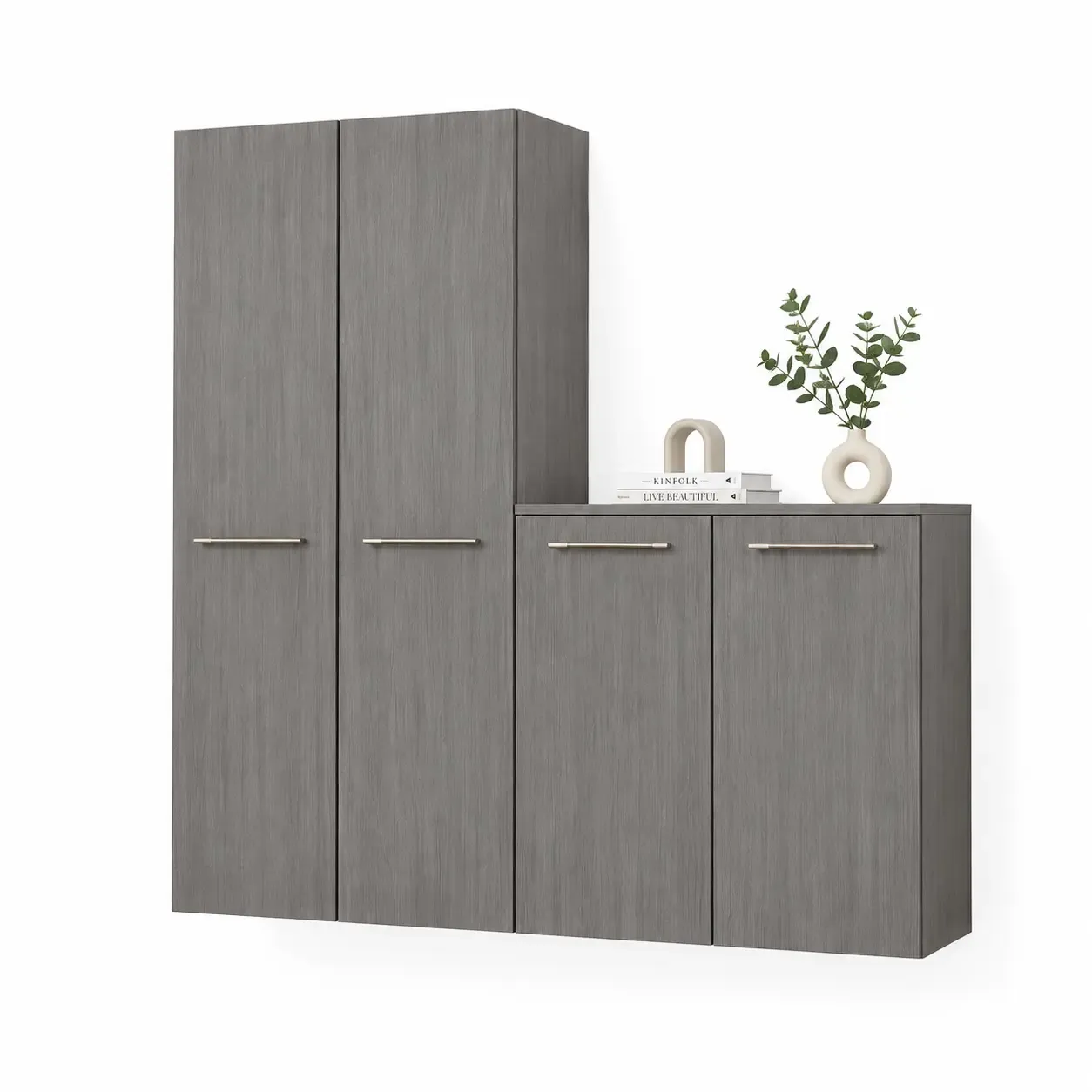
- Floating (wall-hung) cabinet. Lifting the unit off the floor makes a small entrance feel bigger, keeps the base dry when the floor is mopped, and lets you slide daily slippers underneath.
What drives shoe cabinet price in Malaysia
Quotes vary widely, and the headline material is only part of it. When comparing a custom made shoe cabinet with a ready-made one, look past the number at four things.
- Size and configuration. Price tracks linear metres and height far more than style; a floor-to-ceiling run costs more but stores several times as much per square metre.
- Material and core grade. Aluminium sits above plywood, plywood above melamine board; a quote that undercuts the market usually runs a thinner aluminium gauge or a plain particleboard core.
- Hardware. Soft-close hinges, flip-door mechanisms and adjustable shelf pins keep a cabinet feeling good in year five — the first things a cheap quote removes.
- Fit. A ready-made unit leaves gaps at the sides and a dust ledge on top; custom work is measured to your wall.
TD Furniture has manufactured factory-direct since 2002 from a 200,000 sq ft plant in Lahat, Perak, so a custom shoe cabinet carries no showroom-brand retail markup. See the customisation options for finishes and configurations, or bring your entryway measurements to one of our showrooms across Perak and Penang — the store locator has the nearest one.
Shoe cabinet questions, answered
How deep should a shoe cabinet be?
For flat shelves, aim for an internal depth of 30 to 35 cm so an adult pair sits straight. Angled shelves let a unit of roughly 25 cm work, and tilt-out flip compartments bring it down to about 17 to 20 cm.
Why does my closed shoe cabinet smell, and how do I fix it?
It is almost always trapped moisture rather than dirt. Fix it at the design level with ventilated or louvred doors, vents at the back and an open bottom shelf, then keep the cabinet no more than about 80% full and never store shoes that are still damp.
Is an aluminium shoe cabinet better than a wooden one in Malaysia?
For an exposed position, generally yes: aluminium does not absorb water, will not swell or rot, is termite-proof and can be perforated for built-in airflow. For a sheltered indoor entryway, moisture-resistant plywood or E0 melamine board with sealed edges gives a warmer look at lower cost.
