
Dressing Table Malaysia: A Practical Buying Guide
How to choose a dressing table in Malaysia — vanity sizing and clearance, mirror and lighting choices, storage, and finishes that survive our humidity.
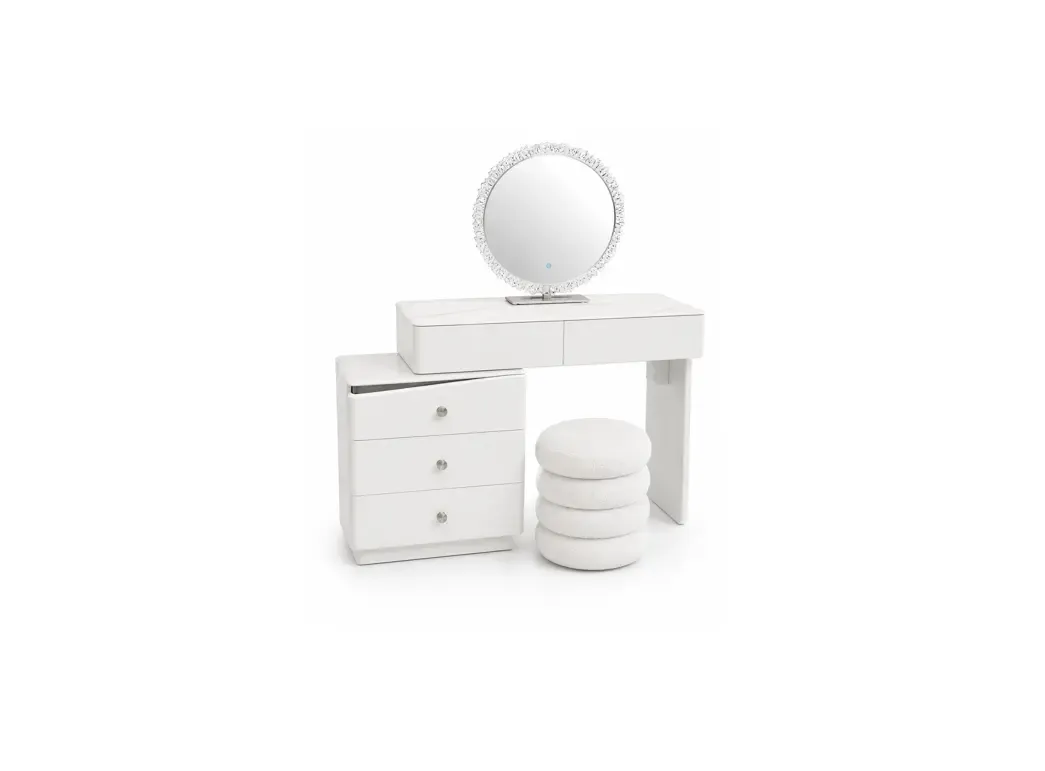
A dressing table is one of the few pieces of furniture you use at close range, every day, usually in a hurry. Get it right and your morning routine has a home: good light, a clear surface, everything within reach. Get it wrong and it becomes an expensive shelf for clutter. Choosing a dressing table in Malaysia adds two local twists — condo and terrace bedrooms are often tight, and our year-round humidity is unkind to poorly finished board. As a Malaysian factory building bedroom furniture since 2002, here is how we would work through the decision, from choosing the table to the mirror, the lighting and the finish.
Dressing table, vanity or console: know the difference
These names get used interchangeably in showrooms and online listings, but they describe genuinely different pieces — and knowing which one you want saves you from buying something that looks right and works badly.
- Dressing table — the classic bedroom piece: a sit-down-height top, drawers below, and a mirror attached or hung above. It handles makeup, skincare, hair and jewellery, and the drawers do real storage work.
- Vanity table — in practice a slimmer, more focused version built around makeup and skincare. A vanity is usually narrower and shallower, which is exactly why it suits a compact condo bedroom.
- Console plus mirror — a slim console with a large mirror above. It looks beautiful, but most consoles sit at standing height (around 85–90 cm), so you cannot comfortably sit at one.
- Wardrobe-integrated vanity — a dressing counter built into a run of wardrobe, sharing the same finish and often the same lighting. The cleanest answer in a small room, because it uses wall depth you have already committed to. Our built-in wardrobe design guide covers how these runs are planned.
Dressing table sizes for Malaysian bedrooms: the numbers that matter
Start with the wall. In a master bedroom, the best spot is one that is not in the path between the door, the bed and the bathroom — and facing a window beats backing onto one. Daylight on your face is accurate and flattering; daylight behind your head throws the whole face into shadow and quietly pushes you to overdo your makeup.
In a small condo or second bedroom, ask honestly whether a standalone table earns its floor space. A narrow vanity tucked beside the wardrobe, a dressing counter built into the wardrobe run, or a slim table that doubles as a desk will usually serve you better than furniture that blocks a walkway.
- Height: a sit-down top usually lands around 72–80 cm. Anything near 85 cm is console height and leaves you perched with your shoulders up.
- Width: 75–120 cm suits most bedrooms. A compact 60–75 cm vanity covers daily makeup and skincare; 100 cm and above feels generous.
- Depth: 35–45 cm is the sweet spot. Below 35 cm bottles crowd the edge; beyond 50 cm you are building a desk that eats the room.
- Knee clearance: at least 60 cm from floor to the underside of the top or drawer apron, with nothing catching your thighs when the stool is pulled in.
- Stool height: around 45–55 cm, chosen so roughly 25–30 cm is left between seat and tabletop — that gap is what lets your forearms rest instead of hover.
- Floor clearance in front: about 75–90 cm of clear floor so the stool pulls out and you can sit and turn. This is the measurement people forget, and it decides whether the table gets used.
One practical trick: mark the footprint on the floor with masking tape, including the pulled-out stool, and live with it for a day. If you keep stepping around it on the way to the bathroom, move it before you buy, not after.
Choosing the mirror: wall-mounted, table-mounted or LED ring
The mirror is what turns a table into a dressing table with mirror, and there are three common ways to do it. None is objectively best — they suit different rooms and routines.
Wall-mounted mirror
Hanging the mirror keeps the tabletop completely free and lets you go large; a tall rectangular mirror also reads as a design feature and bounces light around a small bedroom. The trade-off is commitment — a fixed position, holes in the wall, and a height set for whoever sits there most. Seated, you should see your whole head and shoulders with a little room above your hair.
Table-mounted and tri-fold mirrors
A mirror fixed to the table arrives at the right height by design and moves with the furniture — ideal for renters. A tri-fold mirror adds two hinged side panels so you can see your profile and the back of your head, which matters enormously for hair, brows and earrings. The cost is footprint: side panels eat usable tabletop, so pair one with a wider table rather than a 60 cm vanity.
The round LED ring mirror
The round vanity mirror with an integrated LED ring has become the default in newer Malaysian bedrooms for a simple reason: it is a mirror and a light in one object, so you stop depending on the ceiling. The ring surrounds your face with even light from the front, which is precisely the geometry that kills shadows. Look for diffused light rather than a row of visible bright dots, and dimmable brightness — full power at 7am is a shock. Size it at roughly two-thirds the width of the table so the proportions look deliberate.
Lighting: why the ceiling light is working against you
This is the most under-rated decision in the whole purchase. A ceiling downlight sits above and behind you when you lean toward the mirror, so it lights the top of your head and drops shadows into your eye sockets, under your nose and along your jaw. You compensate with more product than you need — then step outside and see the result in daylight.
What you want is front-facing light at face height: a ring around the mirror, LED strips down both sides, or two small lamps flanking it. Light from the front and both sides fills shadows in evenly instead of carving them.
- Colour temperature: neutral white around 4000K is the safest all-rounder — a good compromise between warm room light and true daylight. Warm white (2700–3000K) feels cosier but can hide a heavy hand with foundation; above 5000K reads cool and clinical.
- Adjustable beats perfect: mirrors that switch between warm, neutral and cool let you preview your face under the light you will actually be seen in.
- Look for high colour rendering: a CRI of 90 or above means colours read true, so the lipstick you pick is the lipstick you get.
- Even, not bright: soft light from both sides beats one powerful source. Glare makes you squint, and squinting is a poor position for eyeliner.
- Plan the power point before installation, so no cable trails across the tabletop or around a drawer.
Storage: shallow drawers, dividers and a clear tabletop
The tabletop is not storage — it is workspace. Everything left standing on it is one more thing to move, dust around and knock over. Good storage design keeps that surface clear, and the trick is matching each drawer to what goes in it.
- Shallow drawers win for cosmetics. A drawer 8–12 cm deep lets palettes, brushes and tubes lie flat and be seen at a glance. Deep drawers become archaeology, with products expiring unseen.
- Zone with dividers or shallow trays — daily base products in front, colour in the middle, tools and spares behind. Cheap acrylic organisers do more for a routine than an extra drawer.
- Add a matching drawer chest for bulkier things: hair tools, refills, larger bottles. A chest of drawers in the same finish reads as a designed set rather than an afterthought.
- Line the jewellery drawer. Soft compartments keep chains untangled and stop metal scratching the base.
- Leave one clear zone on the top, roughly shoulder-width, so there is always somewhere to set down whatever you are using.
Finishes: surviving the humidity and matching the room
A dressing table faces two enemies in a Malaysian home: humidity and liquids. Bedrooms sit beside bathrooms, air-conditioning cycles on and off, and the top regularly meets spilled toner, nail polish remover, serum and hairspray overspray. How the piece is built matters more than its colour — and then that colour has to live alongside everything else in the room.
Built for the Malaysian climate
- Moisture-resistant board. For anything on a bathroom-adjacent wall, ask for a moisture-resistant grade of engineered board rather than standard particleboard — it holds its shape far better in humid air.
- Sealed edges are the weak point. Board swells where moisture gets in, and that is almost always a raw or badly bonded edge. Thick, properly bonded edge banding is what makes a table last.
- Easy-clean surfaces. A good laminate or melamine top wipes down after a spill and shrugs off the alcohol in most beauty products. Painted or open-grain timber stains more easily.
- Ventilate. Leave a small gap behind the unit and avoid pushing it flush against an exterior wall that stays damp; airflow does half the preservation work for free.
In our climate, what fails first is never the design — it is the edge of the board and the finish on the top. Buy for the humidity and the colour will still look good in ten years. — TD Furniture
Matching the wardrobe, bed and side tables
A dressing table sits in the same eyeline as the bed, the wardrobe and the nightstands, so it is one of the easiest pieces to get visually wrong. The simplest route to a room that looks designed rather than assembled is to treat them as one family: same finish, same handle style, same wood tone.
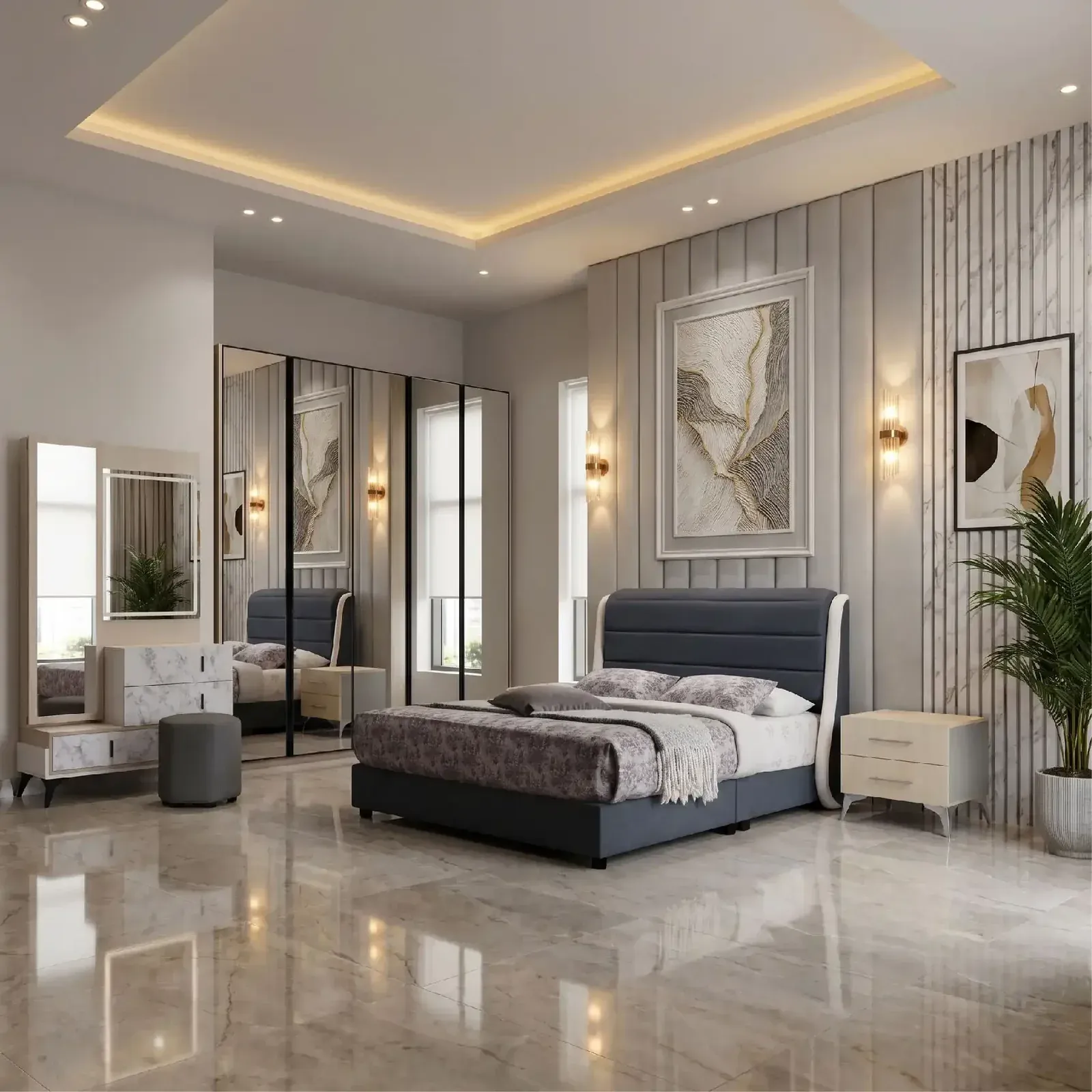
- Start from the biggest piece. The wardrobe and bed frame dominate the room, so let them set the finish and let the dressing table follow.
- Echo the nightstands. Matching side tables and a dressing table in the same finish tie the two halves of the room together.
- Buy as a set where you can. A coordinated bedroom set removes the guesswork on tone and hardware, and is usually better value than collecting pieces one at a time.
- Repeat the mirror shape. If the wardrobe has mirrored panels, a large rectangular vanity mirror feels intentional; without one, a round mirror softens all the straight lines.
- Finish the room properly. Once the furniture is settled, the piece that decides how the bedroom actually feels is the mattress — our mattress buying guide covers that choice in detail.
Frequently asked questions
How do I mount a heavy vanity mirror safely?
It depends entirely on what the wall is made of, so test it first: a solid brick or concrete wall sounds dull when you knock, while a plasterboard or drywall partition sounds hollow. Masonry needs a hammer drill, the right plugs and screws rated well above the mirror's weight. On plasterboard, never rely on a plastic plug alone — fix into the metal or timber studs behind the board where you can, or use proper hollow-wall anchors such as toggle or butterfly fixings, spreading the load across two or more points. If you are unsure, a table-mounted or wardrobe-integrated mirror avoids the question completely.
Ready-made or customised: which should I choose?
Ready-made wins on speed and price. If a standard size fits your wall and the finish is close enough to your wardrobe, you can see it, buy it and take it home in a normal shopping trip. Customising wins on fit: an awkward wall, a beam or column in the way, a non-standard width, or a finish that has to match cabinetry you already own. The trade-off is lead time, because the piece is made after you order, and a site measurement is worth doing rather than trusting a rough guess. A useful rule — if the gap you are filling is unusual, or the dressing table must read as part of a wardrobe run, customise; if it is a standard alcove in a standard bedroom, buy ready-made.
How do I clean nail polish remover or skincare off a laminate top?
Speed matters more than the cleaner. Blot spills immediately with a dry cloth rather than wiping them outward, then clean with a cloth dampened in warm water and a little mild detergent, and dry the surface afterwards — especially along the edges and seams, where standing liquid is what eventually lifts edge banding. Acetone-based remover and alcohol-heavy toners are fine in passing but should never be left sitting. Avoid scouring pads, bleach and strong solvents, which dull the laminate permanently. For anything that regularly drips — foundation, oils, remover — a small tray under the bottles is the cheapest protection there is.
A short pre-purchase checklist
- Sit at it in the showroom with the stool pushed in — knees clear, forearms resting easily.
- Decide the mirror type before the table, because it dictates the width you need.
- Ask what board is used and how the edges are sealed.
- Open the deepest drawer fully and check the runners take the weight smoothly.
- Photograph your wardrobe and bed finish and compare tones in daylight, not on a screen.
- Confirm delivery, assembly, and who fixes the mirror to the wall.
TD Furniture has built bedroom furniture in Malaysia since 2002 and sells factory-direct, so you can compare finishes across the whole bedroom range and have a piece sized to your wall. Bring your room measurements to a showroom in Perak or Penang and sit at a few before you decide — five minutes on the stool tells you more than any product photo.
