
Console Table or Sideboard? A Malaysian Buying Guide
Console table or sideboard? How to choose for a Malaysian home: typical heights, depths and lengths, walkway clearances and materials for humidity.
A console table is often the first thing a guest sees and the last place you drop your keys, yet most people choose one by eye rather than with a tape measure. Its longer, deeper cousin, the sideboard, does the heavy storage work in the dining room. Listings often use the two names interchangeably, so it is easy to end up with a piece too deep for the foyer or too shallow for the dinner plates. If you are shopping for a console table in Malaysia, this guide answers two questions: console table or sideboard, and what size? You can see the shapes we discuss in our console tables and sideboards range.
Console table vs sideboard: what is the difference?
The short answer is depth and storage. A console table is a slim surface, usually on legs, for a few things on top; a sideboard is a low, long cabinet built to hold a lot inside.
- Console table. Typically 25–40 cm deep and 75–90 cm tall, with an open frame, a slim drawer or a lower shelf. It suits entryways, corridors and the space behind a sofa, where you mainly need a landing spot for keys, a lamp or a mirror.
- Sideboard (buffet). Usually 40–50 cm deep, 75–90 cm tall and 120 cm or longer, with closed cupboards and drawers for crockery, table linen, serving dishes or board games.
- In-between pieces. A narrow sideboard around 30–40 cm deep gives a hallway hidden storage without the bulk of a full buffet. Long, low hall cabinets that double as a TV console belong to the same family.
Where each piece works in a Malaysian home
- Condo foyer or terrace-house entrance. Many entrances are tight, with a shoe cabinet already claiming one wall. A console 25–35 cm deep gives you a key tray and a mirror for a last check without narrowing the path.
- Behind a sofa. In an open-plan living and dining area, a console behind a floating sofa hides its back, holds a pair of lamps and draws a soft line between the two zones.
- Under a wall-mounted TV. A low console or sideboard hides the set-top box, router and cables and anchors the screen. This job needs a lower, wider piece; our TV cabinet design guide covers it in detail.
- Dining room buffet. The classic sideboard job: a serving surface for festive meals and steamboat nights, with cupboards for the good plates and drawers for cutlery and placemats.
- Hallway, landing or beside the altar. A narrow console fills a long blank wall upstairs, and a closed sideboard beside the family altar keeps joss sticks, candles and prayer items tidy.
Console table size and sideboard dimensions
Use these typical ranges as a starting point, then check them against your own walls.
| Piece | Height | Depth | Length |
|---|---|---|---|
| Entryway console table | 75–90 cm | 25–40 cm | 80–150 cm |
| Sofa table (behind a sofa) | At or just below the sofa back | 25–40 cm | Half to two-thirds of the sofa |
| Low console under a TV | 40–55 cm | 40–45 cm | TV width plus 30–60 cm |
| Narrow sideboard | 75–85 cm | 30–40 cm | 90–140 cm |
| Dining sideboard (buffet) | 75–90 cm | 40–50 cm | 120–180 cm |
Length: work from the wall
A console table or sideboard looks right at about two-thirds of its wall's width, or up to three-quarters on a long, bare wall. Leave at least 15–30 cm of visible wall on each side, clear of switches and door frames. Behind a sofa, aim for one-half to two-thirds of the sofa's length so the table never pokes out past the arms.
Height: match what sits next to it
Most console tables stand 75–90 cm tall, comfortable for putting down keys while standing. Behind a sofa, keep the top level with the sofa back or up to about 5 cm lower, or it looms over whoever is sitting. In the dining room, a sideboard at or slightly above the usual 75 cm table height makes a natural serving counter.
Depth and clearances
Depth decides whether a hallway still feels like a hallway. Measure the corridor, subtract the depth of the piece and check what is left:
- Walkways: keep about 90 cm clear on a main route and avoid going much under 75 cm.
- Front door: mark the door's full swing on the floor, handle included, and keep the console outside it.
- Sideboard doors and drawers: measure with them open. A hinged door needs roughly its own width to swing, and you need room to stand at an open drawer.
- Dining chairs: leave at least 90 cm between the table edge and the sideboard so chairs can be pulled out, and 100–120 cm if people need to walk behind seated guests.
If your wall is an awkward length or the corridor needs something unusually shallow, ask us about custom sizes. TD Furniture builds whole-house custom furniture made to exact measurements, so storage can be planned around a tricky wall rather than squeezed into it.
Materials and finishes for Malaysia's humidity
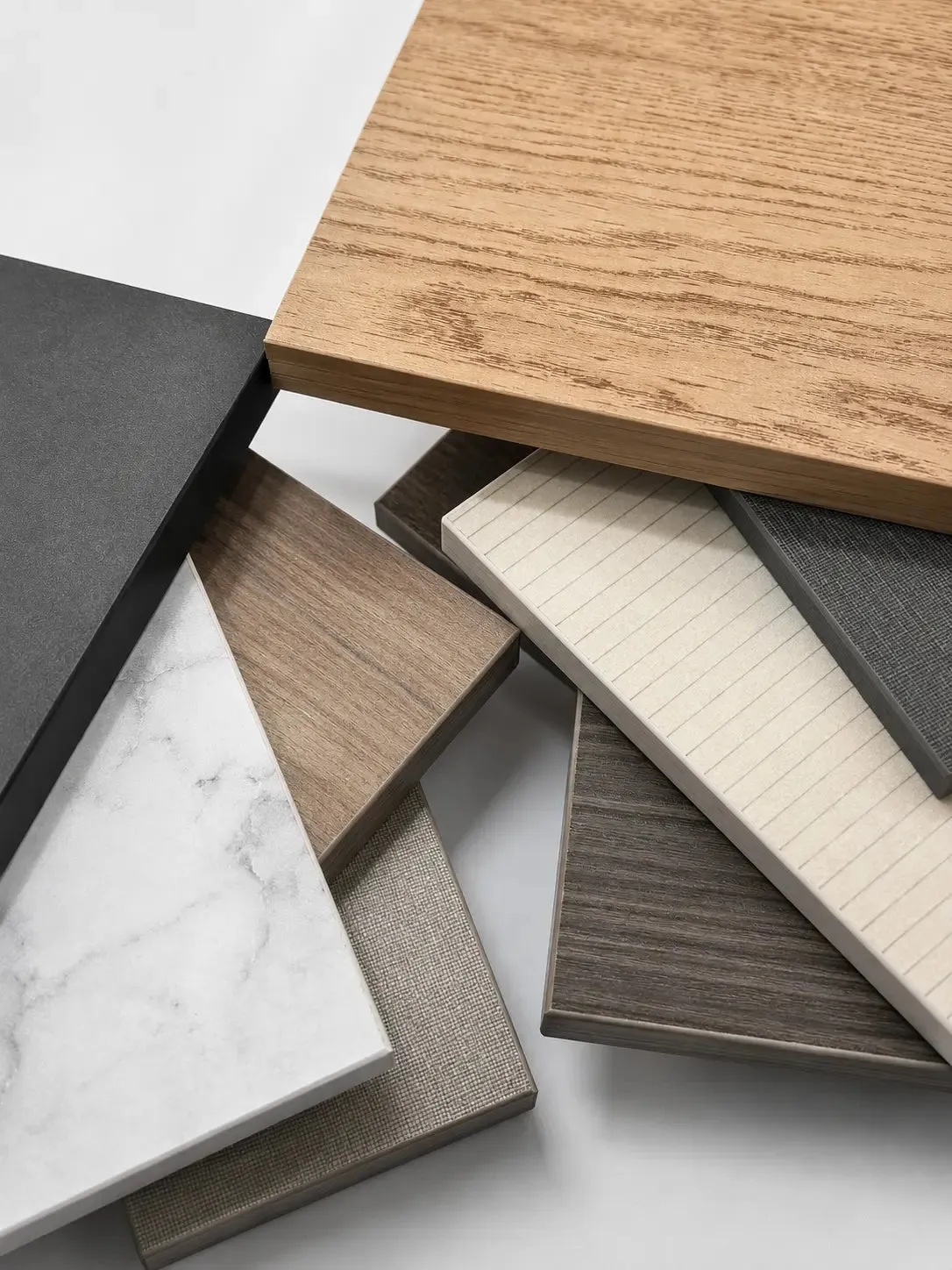
Humidity is hard on furniture that stands against a wall, and entryways get the worst of it, with damp air and rain coming through the front door. Wood-grain, marble-look and matt solid-colour finishes can sit on very different materials, so ask what is underneath.
- Solid wood. Warm, sturdy and refinishable, but timber swells and shrinks with the air. Look for kiln-dried timber, a finish that seals every face, including the underside and back, and joints that allow slight movement.
- Engineered board with laminate or veneer. More stable than wide solid panels, with the widest choice of colours and grains. Its weak point is the edge: moisture enters raw or poorly bonded edges first and makes them swell, so check that every edge is tightly banded.
- Sintered stone. Non-porous and heat-tolerant, so spills sit on top instead of soaking in. A practical top for a dining sideboard used as a serving counter, though a hard knock can chip an edge.
- Natural marble. Every slab is unique, but marble is porous and reacts to acids: wine, citrus juice and vinegar-based cleaners can leave dull etch marks. Use coasters and re-seal it periodically.
- Metal frames. Powder-coated steel legs keep a console visually light and will not swell. Check the welds and coating, since chips can rust, especially in coastal homes.
Whatever the material, leave a small gap behind it for airflow, keep it out of the rain splash zone by the door and add felt pads under the feet.
Storage: open shelf, drawers or closed doors
- Open frame or lower shelf. Light and airy for a small foyer, but everything is on show. Baskets on the lower shelf hide everyday clutter.
- Drawers. The entryway's best friend: keys, access cards, chargers and receipts disappear. Pull each drawer out fully in the showroom to check it runs smoothly.
- Closed doors. The sideboard's strength, keeping plates, glassware, table linen and festive decorations dust-free. An adjustable shelf lets you fit tall bottles or a small appliance.
- Ventilation for electronics. A router or set-top box shut in a cabinet runs hot, and solid doors can weaken Wi-Fi. Choose an open compartment, slatted doors or cable cut-outs, with a few centimetres of space around each device.
How to style a console table or sideboard
Restraint works better than quantity. Most good arrangements combine three things at different heights:
- Something tall, such as a table lamp or a vase of branches at one end; a lamp also gives the foyer soft evening light.
- Something on the wall: a mirror about two-thirds to three-quarters of the table's width, hung roughly 15–25 cm above the top so the two read as one piece.
- Something practical, like a tray or bowl for keys, so the rest of the top stays clear.
Leave about a third of the surface empty. On a dining sideboard, keep the centre free for serving dishes during festive meals.
Common mistakes and care tips
Mistakes to avoid
- Choosing by length alone and losing the walkway to depth.
- Placing a console inside the swing of the front door.
- Buying a sofa table taller than the sofa back.
- Shutting the router and set-top box behind solid doors with no cable openings.
- Pushing a sideboard so close to the dining table that chairs cannot be pulled out.
- Putting a piece with exposed board edges beside a damp front door.
Simple care
Dust with a soft, dry cloth and wipe spills straight away with a damp cloth, then dry. Use coasters, and never put a hot dish directly on wood or veneer. Sintered stone needs only mild detergent; marble needs a pH-neutral stone cleaner. Keep the piece out of strong afternoon sun, which fades finishes.
TD Furniture has made furniture in Malaysia since 2002 and sells factory-direct from its 200,000 sq ft factory in Lahat, Perak. Bring your measurements to our showrooms in Perak and Penang and compare finishes side by side.
Frequently asked questions
What is the standard height of a console table?
Most console tables stand about 75–90 cm tall. Behind a sofa, match the sofa back or go up to about 5 cm lower; under a wall-mounted TV, a lower console of around 40–55 cm suits seated viewing.
Can I use a sideboard as an entryway console?
Only if it is shallow. A standard dining sideboard is 40–50 cm deep, which can choke a narrow foyer, whereas a narrow sideboard of 30–40 cm gives you closed storage and still leaves room to walk past.
How long should a sideboard be next to a dining table?
Start at about 60–75% of the table's length, so a 200 cm table pairs with a sideboard of roughly 120–150 cm, and make sure some wall still shows on both sides.
