
Sofa Bed Malaysia: How to Choose One You Can Sleep On
A practical sofa bed buying guide for Malaysia: mechanisms compared, the clearance to measure, mattress support, humid-climate fabric and real RM prices.
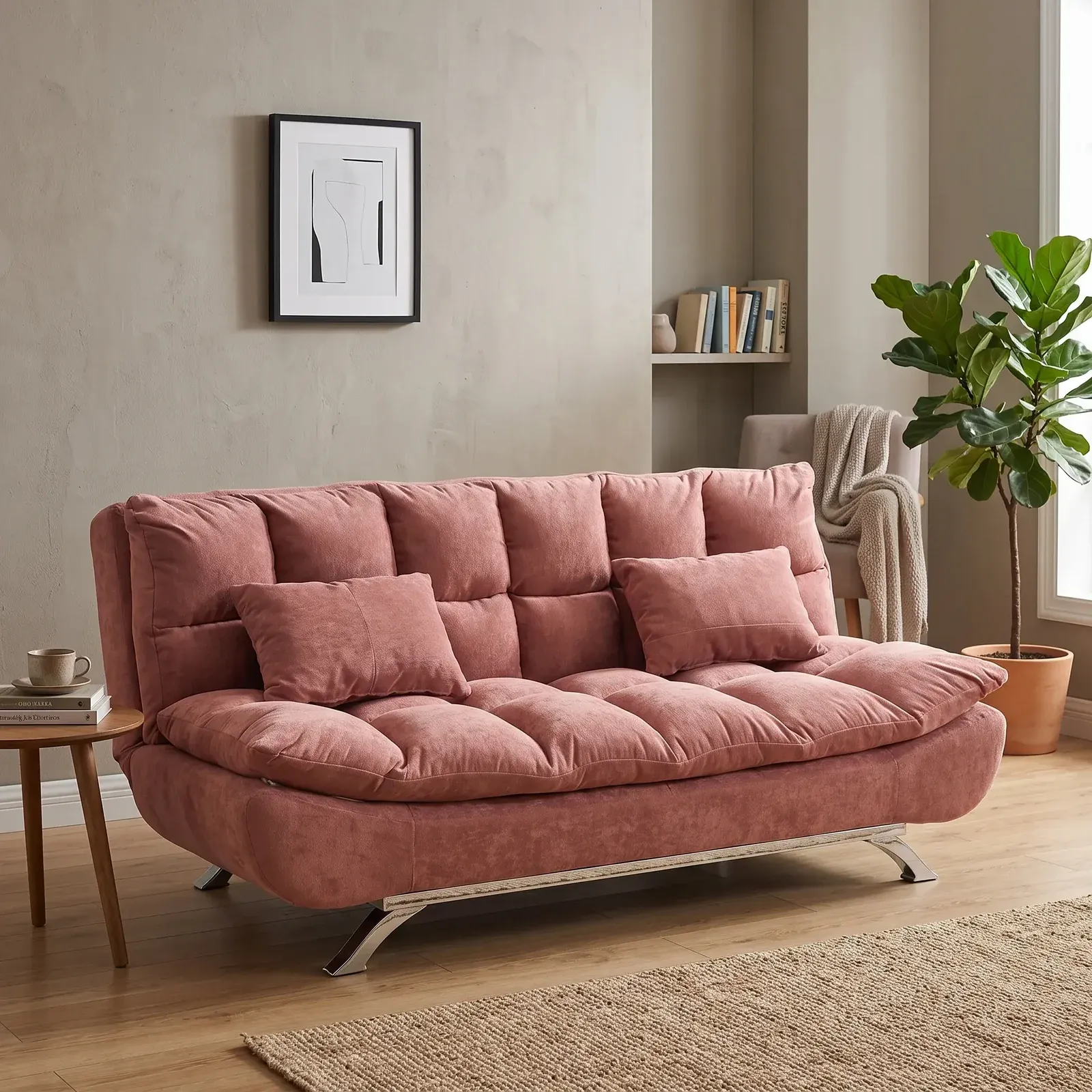
A sofa bed is the only piece of furniture in the house that has to pass two completely different exams. It has to be a sofa you are happy to sit on for three hours with the TV on, and it has to be a bed someone can sleep on without quietly resenting you in the morning. Plenty of them pass one and fail the other. Buying a sofa bed in Malaysia adds two local complications on top: condo and apartment living rooms that are genuinely tight once a coffee table is in, and humidity that decides which upholstery is still fresh in year three. This guide walks through the same checks we go through with customers in the showroom — who a sofa bed actually suits, how the conversion mechanisms differ, the clearance you must measure before you order, what makes a sleeping surface bearable, which fabric to pick for our climate, and an honest look at when you should buy a sofa and a separate mattress instead. Our own sofa bed range sits between about RM999 and RM2,199, so we will use it to anchor the numbers.
Who a sofa bed is really for
A sofa bed is a compromise by design, and it is a brilliant one when the alternative is an empty room you cannot afford to keep empty. It is a poor one when it is bought as a way to avoid buying a proper bed. These are the situations where it consistently earns its place.
- The guest room you do not have. Most Malaysian condo units are two or three bedrooms with every one of them spoken for. A convertible sofa in the living room or study turns an occasional problem — parents visiting from Ipoh for a weekend, a cousin staying over after a wedding — into a five-minute job, without a spare bed sitting unused for 360 nights a year.
- Studios and small apartments. When the living room and the bedroom are the same room, a sofa bed is not a compromise, it is the correct furniture. Here you want a mechanism rated for nightly use and a genuinely supportive sleeping surface, because this one will be opened every single day.
- Kids' and teenagers' rooms. A single sofa bed or day bed sofa gives a child somewhere to sit and do homework and somewhere for a friend to sleep during the school holidays, in a room that is usually only 2.5 m wide.
- The small TV room or study. A foldable sofa bed lets a study double as overflow sleeping space at Raya or Chinese New Year without permanently surrendering the room to a bed frame.
- Rented and first homes. If you may move in two years, one piece of furniture that does two jobs is easier to shift, easier to budget for and easier to justify than a sofa plus a guest bed.
The conversion mechanisms, and what each one costs you
Almost every sofa bed on a Malaysian showroom floor uses one of four conversion systems. The mechanism decides three things at once: how good the bed is, how much floor space it eats when open, and how likely it is to still work smoothly in five years. Pick the mechanism before you fall in love with a colour.
| Mechanism | How it converts | Sleeping comfort | Best for |
|---|---|---|---|
| Click-clack | The backrest tilts down flat in one motion, often with an audible click at each stop. | You sleep on the seat and back cushions themselves, so it is only as good as that foam. Fine for a night or two. | Occasional guests, small rooms, tight budgets. The simplest thing to operate single-handed. |
| Pull-out | The seat cushions lift off and a folded metal frame with its own mattress pulls forward out of the base. | The most bed-like sleep, because there is a dedicated mattress rather than seat cushions. | Frequent guests and anyone sleeping several nights in a row — if you have the floor space. |
| Fold-flat | The whole sofa folds down into one continuous flat platform, cushions and all. | Even and gapless if the foam is dense; the join line is what you feel on a cheap one. | Studios and daily use, where speed of conversion matters more than anything. |
| Day bed / chaise | Already bed-shaped — a slide-out section or an extendable base adds the width. | Comfortable to lie on any time, not just at night, since it is designed as a lounging surface. | Kids' rooms, reading corners and narrow rooms where a full pull-out will not open. |
The honest trade-off is between sleep quality and floor space. A pull out sofa bed gives the best night's sleep because it carries a real mattress, but it swallows the most room when open and is the heaviest to move. A click-clack asks almost nothing of the room and converts in one movement, but your guest is sleeping on seat cushions — which is perfectly acceptable for a weekend and noticeably less so by the fourth night. Fold-flat designs sit in the middle and are usually the best answer for daily use in a studio.
Measure the open footprint, not the sofa
This is the step that turns a good purchase into a bad one, and it takes ten minutes with a measuring tape and masking tape. A sofa bed has two footprints, and the closed one on the product page is the less important of the two.
- Tape out the open bed on your floor. A single sleeping surface needs roughly 190 cm of length to be usable by an adult — our Malaysian bed size guide has the standard dimensions. Mark the open rectangle with masking tape and live with it for a day before ordering.
- Check what the bed lands on. On a pull-out, the frame swings forward into the space your coffee table occupies. If the table is a heavy marble slab that two people must lift, the sofa bed will quietly stop being used. Plan for a light table you can slide aside, or none at all.
- Leave a walking lane. Keep about 60 cm of clear floor along at least one long side of the open bed so whoever is sleeping there can get out without climbing over furniture, and so the room is still usable at 2am.
- Check the door swing and the TV wall. The open bed must not block the bedroom door, the bathroom door or the route to the kitchen. In a narrow condo living room it is often the door that rules out the deeper mechanisms.
- Measure the delivery route too. Sofa beds are heavier than an equivalent sofa because of the steel mechanism inside. Measure the lift car, the lift door and the tightest staircase turn, not just the room.
The sleeping surface: where cheap sofa beds give themselves away
Two sofa beds can look identical closed and be completely different to sleep on. The difference is in three layers you cannot see from the doorway: the mattress, the support under it and the hardware in between.
Mattress thickness and foam density
Because the mattress has to fold into the base, sofa bed mattresses are thin by design — typically in the region of 10–13 cm (about 4–5 inches), which is what most folding mechanisms are built to close over. Thickness alone is not the story though: a dense foam at 10 cm outperforms a soft, airy foam at 13 cm every time. Press your thumb hard into the surface. Good foam pushes back and recovers its shape immediately; poor foam dents and stays dented, and that is the foam that will have a permanent body-shaped hollow within a year.
What is holding the mattress up
Under the mattress you will find timber slats, a solid board or a steel wire mesh. Slats and boards give even, predictable support. Wire mesh is lighter and cheaper but sags in the middle over time, and on a thin mattress you can feel the grid. Ask to see under the bed before you buy — a showroom that will not lift the mattress for you is telling you something.
The bar in the back
The classic complaint about pull-out sofa beds is the support bar that sits under the sleeper's lower back. It is a real problem on cheap frames with thin mattresses, and it is the single best reason to lie down on the open bed in the showroom rather than sitting on the edge of it. Lie flat for a full two minutes, on your back and then on your side. If you can feel a hard line across your body, either the mattress is too thin for that frame or the frame is badly designed — a 5 cm topper can soften it later, but you should not have to buy your way out of it.
Anyone can test a sofa by sitting on it for ten seconds. A sofa bed has to be tested lying down, with the mechanism open, for at least two minutes — that is the only test that tells you anything. — TD Furniture
Choosing fabric for Malaysian humidity
A sofa bed's upholstery works harder than a normal sofa's. It is sat on, slept on, folded, unfolded and pressed against itself when closed — and in our climate it does all that at around 80% relative humidity. Loose natural weaves such as linen and cotton look wonderful and feel cool, but they absorb moisture, dry slowly and hold on to the musty smell that builds up in a closed-up condo unit. A tight synthetic or blended weave is usually the smarter buy here, and darker or patterned colours hide the traffic that a sofa bed inevitably sees.
It helps that the choice is often an explicit, priced option rather than a guess. Our Belform Multi-Functional Sofa Bed, for example, is offered in four fabric grades — an offer colour from about RM1,389, normal fabric at about RM1,559, a water-repellent fabric at about RM1,759 and a Fiber Tech fabric at about RM1,929 (prices at the time of writing). That spread is a useful way to think about the decision: roughly RM170 to RM200 to move up a grade is cheap insurance in a household with small children, and irrelevant in a spare study that hosts two guests a year.
- Tight weave over loose weave. A dense, flat weave resists the grit and skin oils that grind fibres down, and releases moisture faster after a humid week.
- Water-repellent finishes earn their money with kids. A spill that beads instead of soaking in is the difference between a wipe and a professional clean — on a piece of furniture people eat and sleep on.
- Removable covers, if offered, are a genuine advantage. On a sofa bed the arms and seat front take punishment from the conversion itself, not just from use.
- Vacuum the seams monthly. Dust settled into a weave holds moisture, and that combination — not the fabric itself — is what makes upholstery smell musty in a closed-up unit.
- Air the bed open. Every month or two, open the sofa bed for an hour and let air get to the folded mattress. A mattress that lives permanently folded inside a warm base is the one that develops a smell.
- Keep it out of direct sun. A west-facing window fades fabric and bakes foam faster than daily use does. The same logic applies to any upholstery — our guide to leather versus fabric for recliner sofas goes deeper on how each material ages here.
Frame and mechanism: the parts that fail first
A normal sofa fails at the foam. A sofa bed fails at the hinge. Every conversion puts load through a small number of steel joints, so the hardware matters more here than in any other upholstered item you own.
- Convert it yourself, twice. In the showroom, open and close the bed with your own hands — and then do it again. A mechanism that needs a knee, a shove and a particular knack on day one will not be used on a Tuesday night when a guest is waiting.
- Listen and feel. Smooth, damped movement is a good sign. Grinding, catching or a violent drop at the end of the travel means the geometry or the tolerances are poor.
- Look at the steel. Powder-coated or painted steel resists the surface rust that appears on bare metal in a humid room. Check the welds at the pivot points and the gauge of the tubing — thin, flexy sections are where fatigue cracks start.
- Check the frame material. A solid timber or engineered plywood frame handles the repeated flexing of conversion better than plain particleboard, which crumbles around screw fixings once it starts to move.
- Feel the legs and the floor contact. A pull-out frame's front legs land on your tiles under load. Rubber or felt feet protect a polished tile or vinyl floor; bare metal glides will mark it.
- Ask about parts. The mechanism is the part most likely to need attention in year five. Buying from a manufacturer rather than an importer matters here — we have built furniture in our own Lahat, Perak factory since 2002, so the frame and the hardware are ours to support.
Sofa bed Malaysia prices: what the money buys
At the very bottom of the market you are generally looking at a light folding frame with thin foam — usable for an emergency, punishing for a week. The useful range for something you will keep starts a little above that. Here is our current line-up, to anchor the bands (list prices at the time of writing and subject to change).
| Model | SKU | From (RM) | What it is |
|---|---|---|---|
| Paloma Sofa Bed | SB201 | 999 | Entry point into the range. |
| Gideon Sofa Bed | SB202 | 1,299 | Mid-range model in the line-up. |
| Vion Sofa Bed | SB203 | 1,399 | Upper mid-range model in the line-up. |
| Belform Multi-Functional Sofa Bed | SB123 | 1,389 | Folds flat into a bed; four fabric grades including water-repellent and Fiber Tech. |
| Liam Mini Sofa Bed | SB205 | 2,199 | Compact format designed for apartments, studios and small guest rooms. |
Two things are worth noticing in that table. First, compact does not mean cheap — the Liam Mini is the most expensive piece on the list precisely because engineering a comfortable bed into a small footprint is harder than building a big one. Second, the Belform shows where money goes once the frame is decided: the same sofa bed spans roughly RM540 depending only on the fabric grade you choose.
Reality check: sofa bed, or a sofa plus a mattress?
We would rather you bought the right thing than the thing with our best margin, so here is the honest comparison. A sofa bed is not automatically the answer just because you occasionally have guests.
- Buy a sofa bed if the room has no storage for a spare mattress; if guests come often enough that dragging a mattress out would get old; if you live in a studio and the bed is the bedroom; or if you want the room to look like a living room, not a guest room, the other 360 days of the year.
- Buy a sofa plus a separate mattress if you host two or three times a year and have a store room or a wardrobe top to keep a rolled mattress on. For the same total budget you will get a better sofa and a better night's sleep — pair a proper sofa with a foam mattress from our mattress range, and our mattress buying guide explains which types roll and store well.
- Consider an L-shape instead if your guests are short adults or children and the chaise is long enough to sleep on as-is. It is not a real bed, but it costs nothing extra — our L-shape versus 3+2+1 comparison covers how the two layouts use a Malaysian living room, and the L-shape range shows the chaise depths available.
- Consider a day bed sofa if the room is a study or a child's bedroom rather than the main living room. It sleeps better than a click-clack because it is already a bed shape, and it reads as furniture rather than as a folded-up bed.
- Do not buy a sofa bed as your only sofa if the household is four people who watch TV together every night. A sofa bed seats fewer people comfortably than a 1+2+3 set at the same price, because part of the budget went into the mechanism.
Frequently asked questions
Is a sofa bed comfortable enough to sleep on every night?
Some are, but not all of them. If the sofa bed is your main bed — in a studio, or a room that has no other bed — buy a fold-flat or pull-out model with a dedicated mattress of around 10–13 cm in dense foam, supported on slats or a solid board rather than wire mesh. A click-clack that sleeps you on the seat cushions is fine for a weekend and tiring over months. As a rule, if you will open it more than about twice a week, pay for the mechanism and the mattress rather than the looks.
What size sofa bed fits a Malaysian condo living room?
Work backwards from the open bed, not the sofa. Tape out the open rectangle on your floor — a usable single sleeping surface needs roughly 190 cm of length — then leave about 60 cm of clear walking space along one long side and check the bed does not block the bedroom or bathroom door when open. In a typical condo living room that usually points to a two-seater sofa bed, a compact model such as the Liam Mini, or a day bed rather than a full queen pull-out.
Can you use a normal mattress on a sofa bed?
No, not on a folding mechanism. A standard mattress is far too thick to fold into the base, and forcing one in will strain the hinges and stop the sofa from closing. Replacement sofa bed mattresses are made thin — usually around 10–13 cm — specifically so they fold. What you can do is add a thin topper of about 3–5 cm on top of the opened bed, which is the cheapest fix for a thin mattress or a support bar you can feel. Store the topper folded in a wardrobe between guests.
Which sofa bed mechanism is best: click-clack, pull-out or fold-flat?
It depends on how often you open it. Click-clack is simplest, cheapest and kindest to a small room, and it is the right choice for a couple of guest nights a year. Pull-out gives the most bed-like sleep because it carries a real mattress, but it needs the most floor space and is the heaviest. Fold-flat converts fastest and is usually the best compromise for daily use in a studio. Convert whichever model you are considering yourself, in the showroom, before deciding.
How much does a sofa bed cost in Malaysia?
Our own range runs from about RM999 for the Paloma to about RM2,199 for the compact Liam Mini, with the Gideon at about RM1,299 and the Vion at about RM1,399 in between. The Belform multi-functional model starts at about RM1,389 and rises to about RM1,929 depending on which of its four fabric grades you choose. Prices at the very bottom of the market usually mean a light frame and thin foam that is fine for an emergency but not for regular use. Prices are at the time of writing and change.
Which fabric is best for a sofa bed in Malaysia's humidity?
A tight synthetic or blended weave, in a mid-to-dark colour. Loose natural weaves such as linen and cotton feel cool but absorb moisture, dry slowly and pick up the musty smell that builds in a closed-up unit. If there are children in the house, a water-repellent or performance fabric grade is worth the upgrade — on the Belform, for instance, water-repellent and Fiber Tech grades are offered above the standard fabric. Whatever you choose, vacuum the seams monthly and open the bed for an hour every month or two to air the folded mattress.
