
L-Shape Sofa vs 1+2+3 Sofa Set: Which Fits Your Room?
L-shape sofa or a 1+2+3 sofa set? A practical guide to choosing the right layout for your Malaysian living room, condo or open-plan hall.
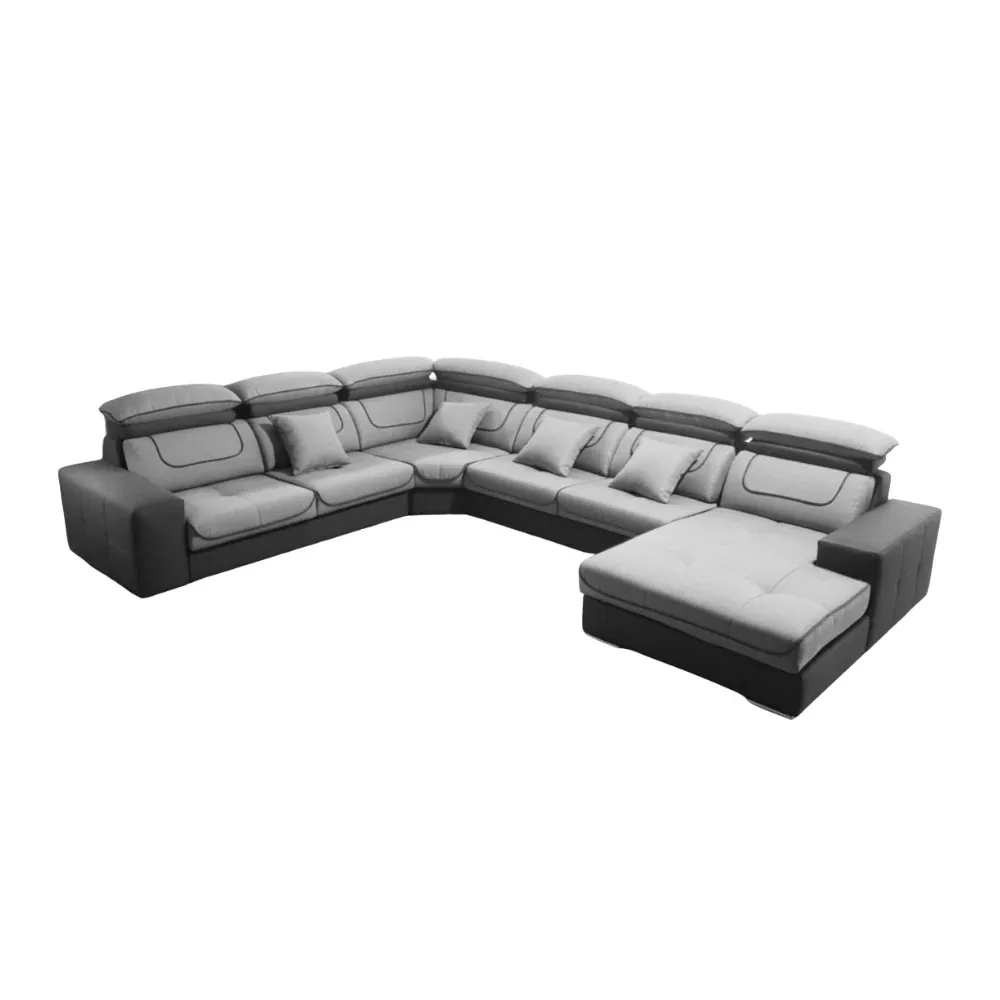
Once you have settled on a sofa, the next question decides how your whole living hall feels: do you buy an L-shape sofa — one connected sectional with a long chaise — or a 1+2+3 sofa set of three separate pieces you arrange yourself? The trap is thinking one is simply better than the other. They can seat the same number of people; the real difference is how they sit in your room. As a Malaysian factory that custom-builds both, here is a practical, layout-first comparison to help you choose the shape that fits your condo, terrace house or open-plan hall — not just the one that looks good in a showroom.
Same seats, two very different layouts
It helps to strip the choice back to what it really is. An L-shape and a 1+2+3 set can both seat five or six people; they cost roughly the same to build in the same fabric and frame. So the decision is not about which is more comfortable or better value in the abstract — it is about room shape, flexibility and how you actually use the space.
Do you have one long wall or an open corner to fill? Do you rearrange your furniture, or move house every couple of years? Is the living hall for stretching out on movie nights, or for sitting and talking with guests? Answer those honestly and the right layout usually picks itself. Everything below is here to help you answer them.
What each layout actually is
Before weighing the pros and cons, it is worth being clear on what you are comparing, because the terms get used loosely in Malaysian showrooms.
- L-shape sofa (sectional / corner sofa) — one connected piece that turns a right angle, usually with a long chaise or lounging seat on one end. It runs along two walls or wraps a corner, and it is built (or delivered in sections that lock together) as a single arrangement. Browse our L-shape sofa range to see the format.
- 1+2+3 sofa set — three separate pieces: a single armchair (1), a two-seater and a three-seater. You place them however you like — facing, in an L around the coffee table, or split across rooms. This is the classic sofa set most Malaysian homes grew up with.
- Corner or U-shape sofa — the bigger cousin of the L-shape, wrapping three sides for large families and open-plan halls. If your space is generous and always full of people, see our corner and U-shape sofas too.
L-shape sofa: the pros and cons
An L-shape sofa is the natural pick when you want to make one corner or two walls do the most work. Because it is one continuous piece, it seats a crowd with no awkward gaps and gives you that long chaise to put your feet up.
- Maximises seating along two walls — it tucks into a corner and uses space most sofa sets waste, which is exactly why small condos often get more usable seats from an L-shape than from three separate pieces.
- Made for lounging and movie nights — the chaise lets someone stretch out fully, and the continuous seat means no gaps between pieces to swallow a cushion or a phone.
- Defines an open-plan zone — in a joined kitchen-dining-living layout, an L-shape acts like a soft wall, marking where the living area begins without closing it off.
- Fewer gaps, cleaner look — one piece reads as calmer and more designed than three that never quite line up.
The trade-offs all come from the same thing — it is one fixed shape. You commit to an orientation on the day you order (more on left-hand vs right-hand below), so it has to be planned against your exact room. It is heavier and harder to move through doorways, lifts and staircases, and in a small hall a large L-shape can dominate everything. And if you move house, it may simply not fit the next room.
1+2+3 sofa set: the pros and cons
A 1+2+3 sofa set wins on flexibility. Three separate pieces can be arranged, re-arranged and split up as your life changes — which is why it remains the default for so many Malaysian families.
- Flexible to arrange — face them for conversation, angle them around the coffee table, or push the single into a reading corner. Rearrange the whole room in an afternoon whenever you fancy a change.
- Easy to move and to fit odd rooms — smaller, lighter pieces go through tight doorways and up stairs far more easily, and they slot into narrow or irregular halls that would defeat one big sectional.
- Replace or add one piece — if the kids wreck the two-seater, you replace that piece, not the whole suite. Need more seats later? Add a chair.
- Great for conversation and formal seating — pieces facing each other suit visiting family and Hari Raya or Chinese New Year open houses, where people sit and talk rather than all face the TV.
The cost of that flexibility is floor area and cosiness. Three separate pieces with their own arms take more total space for the same number of seats, and the gaps between them are less inviting to sprawl across than one continuous L. For pure lounging, a set never quite matches a chaise.
Which layout fits your Malaysian room
This is where the choice is really made. Match the layout to your room shape and how the space is used, rather than to a trend.
- Long, rectangular hall — an L-shape running down the long wall and turning at the end uses the space beautifully and faces a central TV wall naturally.
- Square room — either works, but a 1+2+3 set arranged around a coffee table often feels more balanced and symmetrical here.
- Small condo — a compact L-shape usually gives you the most seats for the footprint; but if there are two walkways crossing the room (door to balcony, door to kitchen), a 1+2+3 set keeps those paths clear.
- Open-plan kitchen-dining-living — an L-shape is the better zone divider, its back marking the edge of the living area.
- You rearrange often or move house — choose the 1+2+3 set every time; it adapts to the next room, an L-shape may not.
- Very tight or multi-use space — consider a sofa bed so the living room doubles as a guest room, or explore the wider living room range for smaller-scale options.
Measure the walls and doorways first
Whichever way you lean, measure before you fall for anything. Note the length of the walls the sofa will sit against, and — crucial for an L-shape — measure your doorways, lift, staircase turns and corridor width so the piece can actually get into the room. Mark the sofa's footprint on the floor with masking tape and live with it for a day; leave at least about 60 cm of walkway around it so nobody has to squeeze past.
Left-hand vs right-hand orientation
An L-shape only fits one way round, so getting the handing right matters. Sit on the sofa and look out into the room: if the long chaise extends to your left, it is a left-hand-facing L-shape; to your right, it is right-hand-facing. Put the chaise on the open side of the room, not blocking a walkway or the TV. Conventions differ between makers, so always confirm the orientation against a floor plan before you order — with a custom build we set it to your exact room.
Seating, size and proportion
Whichever layout you pick, size it to the room and the household — not just to the biggest sofa you can afford. Start by counting the seats you genuinely need day to day, plus a little room for guests, then check the piece against the space around it.
- Count real seats — how many sit down on a normal evening, plus the occasional guest. Buying for the once-a-year full house leaves a hall that feels overstuffed the other 360 days.
- Proportion to the room — the sofa should relate to the coffee table and the TV wall, not swamp them. A giant L-shape crammed into a small hall makes the whole room feel smaller.
- Keep the walkways — that 30–45 cm of clearance around the sofa and between it and the coffee table is what keeps the room comfortable to move through.
- Do not overstuff a small hall — in a tight space, a two-plus-one or a compact L often looks and lives better than a full 1+2+3 forced against every wall.
Comfort and everyday use
Layout also shapes how the sofa feels to live with. An L-shape with a chaise is built for lounging and napping — ideal if your living room is really a TV-and-relax room, or if someone in the house likes to stretch out. A 1+2+3 set suits conversation and more formal seating, where guests sit facing one another; it is the sociable choice for a home that entertains.
For homes with pets and young children, the flexibility of a set has a practical edge — you can replace one wrecked piece rather than the whole suite, and move pieces to protect them. Whichever you choose, removable, washable covers are worth asking for in our climate; they make spills, fur and sticky little hands far easier to live with. (We keep that a footnote here — fabric and leather deserve their own guide.)
Quick decision checklist
- Choose an L-shape sofa if — you have a corner or two walls to fill, love lounging and movie nights, want to zone an open-plan hall, are staying put in this home, and can get the piece through the doorways.
- Choose a 1+2+3 sofa set if — your room is square or has crossing walkways, you rearrange or move often, you entertain and value face-to-face seating, or you want to replace and add pieces over time.
- Consider a corner / U-shape if the hall is large and always full of people; a sofa bed if the room must double as a guest room.
Frequently asked questions
Is an L-shape sofa better than a 1+2+3 sofa set?
Neither is better outright — they suit different rooms. An L-shape maximises seating in a corner, is made for lounging and zones an open-plan hall, but it is fixed in shape and harder to move. A 1+2+3 set is flexible to rearrange, easier to fit and move, and better for conversation, but takes more floor area for the same seats. Match the layout to your room and how you use it.
Is an L-shape sofa good for a small living room?
Often yes. A compact L-shape tucks into a corner and uses space that separate pieces waste, so it can give you more usable seats for the footprint in a small condo. The catch: it must physically fit through your doorways and lift, and it should not block a walkway. If two paths cross the room, a 1+2+3 set may keep the space more open.
What is the difference between an L-shape and a corner sofa?
They overlap. "L-shape" and "corner sofa" usually mean the same thing — one connected sectional turning a right angle with a chaise on one end. A U-shape is the larger version that wraps three sides, for big families and large open-plan halls. Think of L-shape as the two-sided option and U-shape as its bigger, three-sided cousin.
