
Chest Drawer Malaysia: How to Choose a Chest of Drawers
How to choose a chest drawer in Malaysia — drawer counts and heights, sizing to your room, humidity-ready boards, runners and anti-tip safety.
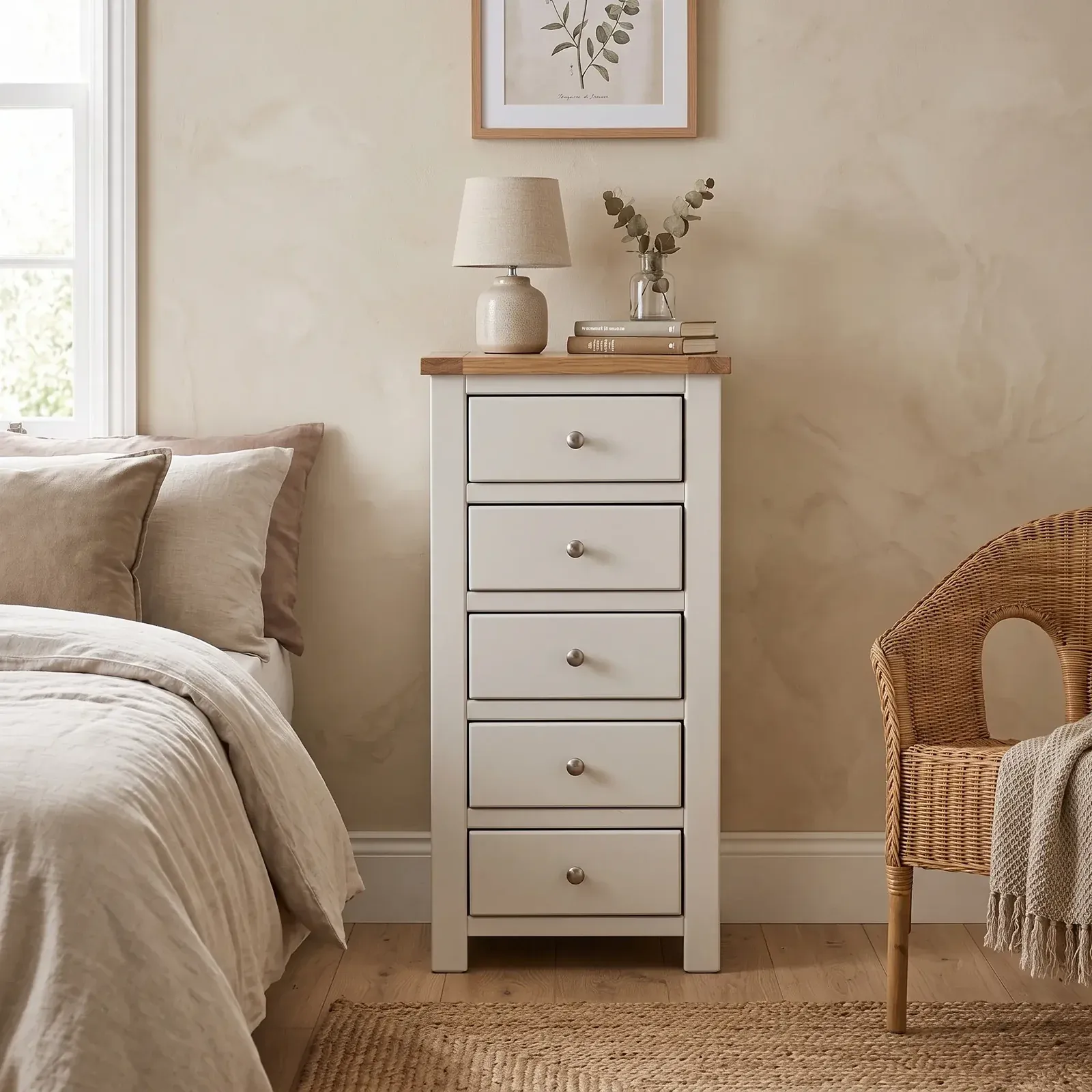
A chest drawer is the quietest workhorse in a Malaysian bedroom. The wardrobe takes the budget, but the folded t-shirts, the socks, the spare bedsheets and the chargers all end up in a chest of drawers — and when a room has none, they end up on the bed. In Malay it is an almari laci. Here is how we would choose one, as a Malaysian factory building bedroom furniture since 2002.
What a chest of drawers is for, and when it beats a wardrobe
A wardrobe solves hanging storage: shirts, dresses, trousers, anything that creases. A chest of drawers solves everything else — usually more than half of what a family owns. For folded clothes, drawers beat shelves: you reach in from above and see the whole layer at once.
They are complements, not alternatives. A wardrobe with two or three internal drawers is enough for one person; a couple sharing a room, or a family with children, runs out of drawer space first — which is when a chest drawer earns its floor space.
- Folded clothing — t-shirts, polos, shorts, pyjamas.
- Small items that get lost on a shelf — socks, underwear, ties, belts, scarves.
- Household linens — spare bedsheets, pillowcases, towels, the thin aircon blanket.
- Bedroom odds and ends — documents, cables, medicine, stationery.
- A usable top surface — a lamp, a key tray, a small TV, which a wardrobe cannot give you.
How many drawers? 3, 5 or a tallboy
Drawer count and height move together: more drawers in the same width means a taller unit. Which is right depends on your floor plan, not on how much you own.
3-drawer chest: the low all-rounder
Low enough to sit under a window without blocking the light, and to double as an oversized bedside unit. It can later move to a hallway, study or nursery, which makes it the most flexible piece in the category. The trade-off is capacity: three drawers fill within a year in a shared room.
4 to 5 drawers: the bedroom workhorse
The configuration most people should buy. Enough drawers to separate categories properly — shallow top drawers for socks and underwear, deeper lower drawers for folded shirts and jeans — with the top still at a comfortable height to use as a surface.
6 drawers and up: the tallboy
A tallboy is a tall, narrow chest of drawers: height over width. It is the right answer for a tight condo bedroom, because it buys storage upward instead of sideways — similar capacity on roughly half the floor area. Two cautions: tall units must be anchored to the wall, and on a 130 cm unit the top drawer sits around shoulder height for shorter users, so you end up reaching in blind.
| Configuration | Typical height | Best suited to | Watch out for |
|---|---|---|---|
| 3-drawer | 70–85 cm | Under a window, beside a bed, hallway | Runs out of space quickly |
| 4–5 drawer | 90–120 cm | Main bedroom, everyday clothing | Needs a clear wall slot |
| 6+ drawer tallboy | 120–140 cm | Narrow or shared rooms | Anchor to the wall; top drawer is high |
| Wide double chest | 80–95 cm | Couples sharing one bedroom | Wide footprint, often 120 cm+ |
Sizing it to the room: the measurements people forget
A chest of drawers fails for one of two reasons: it does not fit the wall, or the drawers cannot open once it is in place. Almost nobody measures the second one.
- Measure the wall slot, not the wall. Take the clear width between skirting, door frames, curtains, aircon pipes and plug points, and leave 2–3 cm each side.
- Measure the clearance in front. A drawer projects 40–50 cm when fully open and you must stand in front of it, so allow 70–90 cm of clear floor.
- Check every door nearby — bedroom, wardrobe, bathroom. An open drawer and a swinging door in one space is a daily collision.
- Mind the height. Beside a bed, the top looks best within about 10 cm of mattress height; under a window, keep the unit below the sill.
- Measure the route in — lift lobby, corridor turns, staircase landings. Then tape the footprint on the floor, body plus open drawer, and live with it for a day.
Materials that survive Malaysian humidity
Our climate is the real test: year-round humidity, aircon cycling on and off, and the occasional spill. Board that absorbs moisture swells, and a swollen drawer side is a drawer that sticks.
- Engineered board and plywood — the mainstream choice, and a good one at the right grade. What matters is the panel's moisture content and density, not the name on the label. Our carcasses use E0 panels such as MIECO at 16 mm with controlled moisture content, detailed on our quality page.
- Low-grade particleboard — the usual explanation behind a very cheap chest. It is the most moisture-sensitive option and the weakest at holding screws, which is where runners and handles loosen.
- Melamine and laminate — the practical finish here: wipes clean, shrugs off humidity, never needs refinishing. Matte hides fingerprints better than high gloss.
- Solid wood — strongest where it counts, in the drawer boxes. It moves with humidity, so it needs a well-sealed finish.
- Edge banding is the weak point. Board rarely fails in the middle; it fails at a raw or badly bonded edge where moisture gets in. Feel the top edges and the inside of the drawer openings before you buy.
In this climate the finish and the edges decide how long a chest of drawers lasts — not the design. Everything we build has to survive a Malaysian bedroom. — TD Furniture
Drawer mechanics: the part most buyers skip
Two chests can look identical in a photo and feel completely different after a year. The difference is the hardware and the drawer box, and checking takes thirty seconds: pull a drawer right out, press its base, push it closed.
- Runners. Plain roller runners are cheapest and noisiest, and they wear into rough spots. Ball-bearing slides run smoother and carry heavier loads. Soft-close is a damper added to a slide, worth having where children use the drawers.
- Full extension. Insist on it: partial-extension slides leave the back 20–25% of the drawer inside the carcass, so the deepest part of every drawer becomes a dead zone.
- Base thickness. A thin 3 mm hardboard base in a groove sags once the drawer is full of jeans. A thicker base, or one with a centre support rail, holds its shape — press hard in the middle of an empty drawer.
- Box joints and handles. Dowelled, dovetailed or screwed-and-blocked corners survive years of pulling; stapled butt joints work loose and the drawer starts to rack. Bar and D-handles grip easiest.
- Anti-tip hardware. Non-negotiable on anything tall. A chest with a loaded drawer open shifts its centre of gravity forward, and a child pulling on it or climbing can bring the unit down — exactly what international safety standards for clothing storage units test.
Three habits then keep it working:
- Heaviest items in the bottom drawers — better for stability, kinder to the runners.
- Do not overfill — contents above the drawer sides catch on the frame on every close.
- Wipe spills along drawer edges and top seams straight away, and check the anti-tip fixing once a year.
Where to put it, and how to match the room
- Master bedroom — on the wall facing or beside the bed, where it also holds a lamp and a tray.
- Inside a walk-in or built-in wardrobe — drawers built into the run put folded clothes where you dress; our built-in wardrobe guide covers that layout.
- Hallway, entrance or study — keys, umbrellas and mail, or documents, cables and printer paper.
- Nursery and children's rooms — a low, wide chest with a changing mat on top, anchored from day one.
A chest of drawers sits in the same eyeline as the bed, the wardrobe and the nightstands, so a mismatched finish is impossible to ignore. Let the largest piece — usually the wardrobe — set the tone, then repeat two things across the room: the wood tone or colour, and the handle style.
Chest drawer FAQ
How many drawers do I actually need?
For one person sharing a room, four to five drawers is the realistic minimum once linens and small items are included; for a couple, five or six, or two separate chests. In a children's room three or four is enough, if the child can reach it. The test is not how much you own, but how many categories you want kept separate.
Will the drawers sag or start sticking over time?
Sagging comes from a thin, unsupported drawer base — the fix is a thicker base or a centre support rail, which you can test by pressing down in the middle of an empty drawer. Sticking comes from worn roller runners, or board that has swollen in humid air. Ball-bearing slides and properly edge-banded panels prevent both.
Is a chest of drawers safe with toddlers in the house?
Only if it is anchored to the wall. Tip-overs happen when a child opens or climbs the lower drawers, which shifts the centre of gravity forward — the furniture does not need to be pushed. Fix it with the supplied bracket or strap, keep the heaviest contents at the bottom, and never leave more than one drawer open.
What is a chest drawer called in Malay and Chinese?
In Bahasa Malaysia it is an almari laci or almari berlaci; a tall narrow one is almari laci tinggi. In Chinese it is 斗柜 or 抽屉柜. Malaysian shops usually say "chest drawer" or "drawer chest" rather than the full "chest of drawers" — all the same piece of furniture.
TD Furniture has manufactured bedroom furniture in Malaysia since 2002 and sells factory-direct from our Lahat, Perak factory, so board grade, edge banding and runners are our own specification decisions. Torn between a three-drawer chest and a tallboy? Bring your room measurements to a showroom in Perak or Penang and open a few drawers.
